
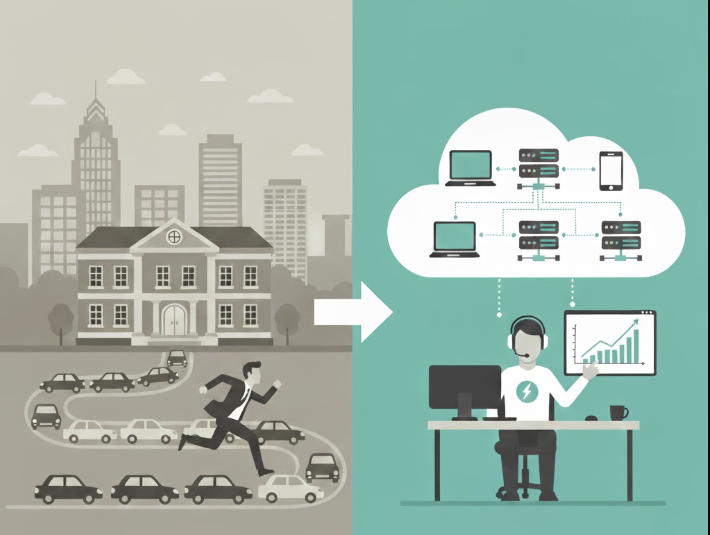
TL;DR: For a modern Charlotte business, the fastest IT support is not the provider with the closest office but the one built for immediate, remote-first resolution. Scottship Solutions measures success in time-to-resolution, backs it with guaranteed SLAs and around-the-clock coverage, and dispatches vetted on-site technicians in the Charlotte area for the rare hands-on job.
When your business’s critical systems go down, your first instinct is to get help fast. For years, the conventional wisdom for Charlotte business owners and organizations has been to find a “local IT company.” The logic seems sound: if they have an office down the street, they can get to you quicker when something breaks. There are many IT companies to choose from, each offering different specializations and services. To find a reliable IT company, check online directories, search engines, local business associations, and ask for referrals. These resources help organizations connect with IT companies and providers that best fit their needs.
But what if that logic is outdated?
In a world where 99% of business operations live in the cloud, on servers, and behind screens, the very definition of “local” has changed. Proximity is no longer the key performance indicator of effective IT support. Responsiveness is.
This guide will challenge the old way of thinking. Here is why, for a modern Charlotte business, the fastest, most effective, and most strategic choice for an IT partner isn’t the one with the closest office, but the one built for immediate, remote-first resolution.
Does Proximity Still Matter for IT Support?
Think about the last IT issue your company faced. Was it a physical hardware failure, like a smoking server? Or was it a software glitch, a network slowdown, a forgotten password, a cybersecurity concern, a problem
For the vast majority of businesses, the issues are digital, not physical. Your data, applications, devices, computers, and workflows don’t live in your physical office space; they exist on a network. So why is the default solution to dispatch a person in a car?
Relying on physical proximity for digital problems is like insisting your fire department be located in your building’s basement. It’s not about being close; it’s about having the right tools and the fastest response time when the alarm bells ring. A traditional IT company service model that prioritizes physical presence often means you’re waiting for a technician to become available, pack their bag, and then begin their journey to your office.
A remote-first approach streamlines the process of troubleshooting and resolving IT issues, ensuring faster and more efficient support.
That delay is more than an inconvenience. It’s a direct hit to your productivity and bottom line.
Which Is Faster, Remote Support or a Local Technician in Charlotte Traffic?
Here is a scenario Charlotte teams know well. It’s 2:00 PM on a Tuesday, and your team suddenly can’t access your CRM. Sales grind to a halt. You call your local IT provider. They identify a technician, who then has to fight through traffic on I-77 or crawl through the congestion around Uptown. Best case scenario, they arrive in an hour. Worst case? Several hours. Then they have to unpack, diagnose, and finally, begin to work.
Now, consider the remote-first model.
You report the same issue. Within minutes, often contractually guaranteed by a Service Level Agreement (SLA), an expert technician is securely connected to your system. With remote support, they can troubleshoot and repair issues quickly by accessing your devices over the internet, minimizing work interruptions. They aren’t in traffic; they are at their station, equipped with advanced diagnostic tools. They see what your employee sees, run diagnostics, and get to the root of the problem. The issue is often resolved before the technician from the “local” company would have even found parking. Remote-first providers deliver faster results and have the ability to efficiently resolve issues for multiple devices, thanks to their expertise and comprehensive approach.
This isn’t an exaggeration; it’s the daily reality of modern IT support. The most critical metric is not “time-to-arrival,” it’s “time-to-resolution.” A remote-first Managed Service Provider (MSP) is architected from the ground up to minimize that metric, ensuring your business gets back online faster than any traditional model can compete with.
Which IT Support Metrics Actually Matter?
When evaluating IT services in Charlotte NC, business owners should evaluate potential providers to determine if their offerings align with specific business needs. It is essential to consider whether the provider can meet or exceed your expectations for service delivery. Business owners should also focus on the benefits of prioritizing service delivery metrics, as these can improve efficiency and reduce risks. Additionally, consider the range of services and metrics available to ensure comprehensive support tailored to your requirements. These are the numbers that directly impact your operations.
1. Guaranteed Response Times (SLAs)
Does your IT provider contractually guarantee how quickly they will respond to your request? A modern, remote-first MSP lives and dies by its SLAs. These agreements should specify response times based on the severity of the issue, ensuring your most critical problems get immediate attention. Ask potential providers to show you their SLAs in writing. This is your insurance policy against downtime.
2. 24/7/365 Availability
Business doesn’t stop at 5:00 PM, and neither do IT problems. A cyberattack can happen overnight. A server can fail on a weekend. A traditional local tech support company with a single Charlotte office is often limited by standard business hours. In contrast, a remote-first company with a distributed team of technicians across different time zones offers true around-the-clock coverage. Your late-night emergency is their mid-day priority.
3. First-Contact Resolution Rate
How often is your issue resolved by the first person you speak with? When you’re limited to the staff on hand at a single physical location, your issue might need to be escalated through multiple tiers of support, causing frustrating delays. A remote-first model provides immediate access to a nationwide talent pool. The technician who takes your call can instantly pull in a specialist in cybersecurity, cloud infrastructure, or network engineering if needed. These are highly trained professionals, often holding certifications such as CompTIA, Cisco, or Microsoft, which confirm an IT company’s technical knowledge and ensure you receive expert assistance.
How Does a Remote-First Model Lower Your IT Costs?
Choosing a remote-first IT partner offers another, often overlooked, benefit: value.
A traditional IT company has significant overhead. They pay for prime Charlotte office space, manage a fleet of service vehicles, and cover the associated insurance and fuel costs. These expenses don’t make your IT support better or faster, but they absolutely get baked into your monthly bill. Transparency in pricing and service agreements is vital to ensure clarity about costs and services provided.
A remote-first MSP operates on a leaner, more efficient model. By shedding the costs of a physical storefront, they can invest more heavily in what actually matters:
- Top-Tier Talent: They can recruit the best IT and cybersecurity experts from anywhere in the country, not just those who live within commuting distance of Charlotte.
- Advanced Technology: More resources are dedicated to investing in the powerful security and monitoring software that keeps your business protected proactively.
- Better Value: These operational efficiencies are passed on to you, the client. You get access to an enterprise-grade team and toolset at a price a traditional local company often can’t match.
A modern remote-first IT services provider delivers comprehensive management through a unified platform, using cloud services to simplify business processes and keep your IT infrastructure well maintained. With your cyber security fully covered, you are protected from evolving cybersecurity threats. These solutions empower employees, enhance customer experiences, and help generate new leads while supporting clients across diverse industries. As an alternative to traditional models, remote-first IT service providers are an integral part of your business strategy, ready to solve complex challenges, help your team learn new technologies, and integrate phone and messages for efficient communication. Tailored specifically for small businesses and small business needs, these providers ensure that your organization receives expert support and proactive management from experienced IT service providers.
But What About Hands-On Support?
This is the most common question, and it’s a valid one. What happens when you genuinely need someone on-site?
While over 95% of IT issues can be resolved remotely, physical intervention is occasionally necessary for tasks like new hardware installation, office moves, or complex network cabling. Infrastructure as a service (IaaS) solutions can support these needs by providing storage, servers, hardware, data center space, and network services.
A strategic remote-first MSP has a robust and tested plan for this. At Scottship Solutions, we manage this through a hybrid approach:
- Strategic Dispatch: For situations requiring hands-on help, we have a network of trusted, vetted on-site technicians in the Charlotte area ready to be dispatched. This is a planned, strategic action, not a chaotic, reactive scramble.
- Hardware as a Service (HaaS): We can procure, configure, and ship hardware directly to your office, pre-configured and ready to plug and play. Your employee simply needs to plug it in, and we handle the rest remotely.
- Scheduled Visits: For larger projects like an office expansion, we schedule planned on-site visits from our own project specialists, ensuring the job is done right, on time, and on budget.
This approach gives you the best of both worlds: the immediate responsiveness of a remote team for daily needs and the planned, expert on-site support for physical tasks, all coordinated through a single point of contact.
How Should You Choose an IT Partner in Charlotte?
Charlotte’s business environment is dynamic and competitive. To thrive, you need an IT infrastructure that is resilient, secure, and efficient. The partner you choose to manage that infrastructure should reflect the realities of how business operates today, not twenty years ago.
Don’t let the outdated notion of “local” hold you back. Proximity is a vanity metric; responsiveness is what drives your business forward. Look for a partner who measures success in minutes-to-resolution, not miles-to-your-office.
Choose an it company service that provides guaranteed SLAs, true 24/7 support, and access to a deep bench of national talent. By embracing a modern, remote-first approach, you equip your Charlotte business with a faster, more effective, and more valuable IT solution built for the future.
Frequently Asked Questions
Is remote IT support faster than a local on-site technician?
Usually, yes. With a remote-first model, an expert connects to your system within minutes, often guaranteed in writing by a Service Level Agreement, while a local technician still has to reach your office through Charlotte traffic. Over 95% of IT issues can be resolved remotely, so the problem is often fixed before an on-site technician would have found parking.
What happens when you need on-site IT support in Charlotte?
For the small share of issues that need hands-on work, such as new hardware installation, office moves, or network cabling, Scottship Solutions dispatches vetted on-site technicians in the Charlotte area, ships pre-configured hardware that is ready to plug in, and schedules planned visits for larger projects, all coordinated through a single point of contact.
What should you look for when choosing an IT support provider?
Look for guaranteed response times backed by written SLAs, true 24/7/365 availability, and a high first-contact resolution rate. These metrics measure time-to-resolution, which matters more for a Charlotte business than how close the provider’s office happens to be.
Does a remote-first IT provider cost less?
Often, yes. A remote-first provider carries less overhead than a firm paying for prime Charlotte office space and a fleet of service vehicles, and those savings can be passed on to you along with access to a national talent pool and enterprise-grade security tools.
Ready to see how a responsive, remote-first approach can transform your Charlotte business’s IT?
At Scottship Solutions, we’re experts in providing world-class managed IT services, cybersecurity, and strategic support to businesses just like yours. Contact us today for a free consultation and discover the difference speed and expertise can make.

Written by
Will Facques
Senior IT Consultant at Scottship Solutions
Will works directly with nonprofit and small business clients on infrastructure, managed services, and technology implementations. He translates complex technical requirements into practical solutions that actually get done.
Certifications
PMP (Project Management Professional) • Lean Six Sigma Yellow Belt • CompTIA Network+
Industries Served
Human Services, Healthcare & Community Health, Education & Youth Development, Faith-Based, Child Advocacy, Arts & Culture