
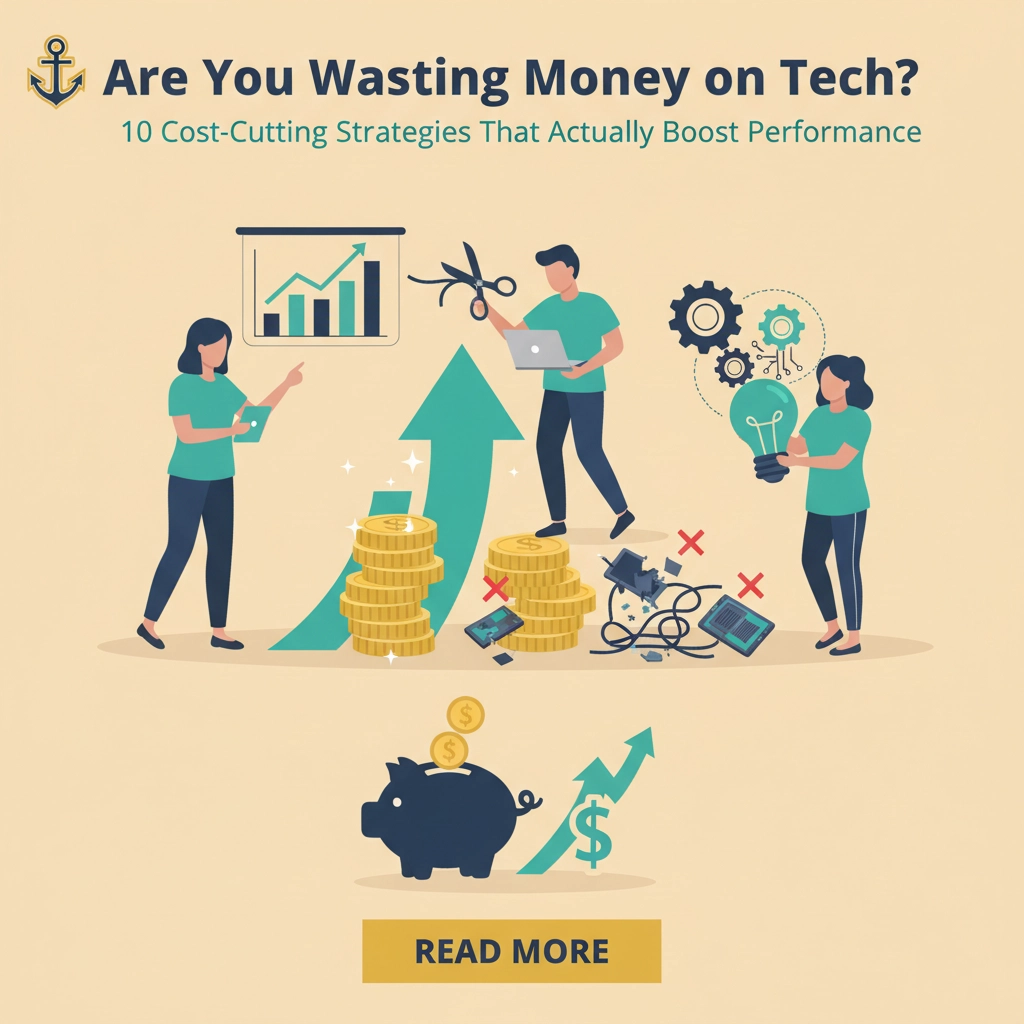
Every month, countless organizations unknowingly hemorrhage thousands of dollars on redundant software licenses, outdated systems, and inefficient processes. If you’re like most nonprofit leaders or small business owners, you’ve probably felt the sting of technology costs that seem to grow faster than your budget, without delivering proportional value.
Aligning IT investments with overall business value is essential, especially in times of economic uncertainty, as organizations must ensure every dollar spent on technology directly supports their strategic goals.
The good news? Strategic cost reduction doesn’t mean sacrificing performance. When done right, smart tech optimization actually strengthens your operations while freeing up precious resources for your mission-critical work. Different business units often have unique technology requirements, so understanding the specific business needs of each unit is crucial for effective IT cost reduction.
Let’s dive into ten proven strategies that will help you slash unnecessary tech spending while supercharging your organization’s efficiency.
1. Conduct a Ruthless Software Audit
Most organizations accumulate software subscriptions like digital dust bunnies. Start by conducting a comprehensive audit of every tool and platform your or
- 1. Conduct a Ruthless Software Audit
- 2. Modernize Your Legacy Infrastructure
- 3. Embrace Smart BYOD Policies
- 4. Automate Repetitive Tasks
- 5. Renegotiate Vendor Contracts Strategically
- 6. Leverage Generative AI for Productivity Gains
- Optimize Cloud Services and Storage for Cost Optimization
- 8. Implement Data-Driven IT Decisions
- 9. Shift from Reactive to Proactive Maintenance
- 10. Foster a Culture of Continuous IT Optimization
- The Strategic Integration Advantage
- Ready to Transform Your Tech Spending?
Create a centralized tracking system to monitor usage patterns and renewal dates. This prevents automatic renewals for forgotten tools, helps identify consolidation opportunities, and is essential for eliminating wasteful spending on unused or redundant software. Many organizations save 20-40% of their software budget simply by eliminating redundancies and downgrades.
2. Modernize Your Legacy Infrastructure
Outdated legacy IT systems represent one of the biggest obstacles to both efficiency and cost control. Technical debt typically accounts for 20-40% of an organization’s total technological value, creating a substantial burden that directly impacts your ability to invest in innovation.
Outdated IT systems can significantly hinder business operations by reducing agility, flexibility, and cost-efficiency. Effective change management is crucial during modernization efforts to ensure a smooth transition and minimize risks.
IT infrastructure modernization, including cloud migration, application rationalization, and adoption of modular architectures, reduces operational costs while improving cybersecurity and scalability. This isn’t just a technical upgrade; it’s about aligning technology with your mission to make operations more flexible and future-ready.
3. Embrace Smart BYOD Policies
Bring Your Own Device (BYOD) policies enable team members to use personal devices for work-related activities, with organizations saving up to $3,150 per employee annually. This cost reduction comes from eliminating device purchases, reducing management overhead, and lowering maintenance expenses.
Beyond cost savings, BYOD boosts productivity since people work more efficiently with familiar devices. This leads to significant efficiency gains, as employees can complete tasks faster and with fewer errors. Implement robust security protocols and clear usage guidelines to maximize benefits while protecting sensitive data.
Additionally, BYOD can help reduce manual tasks related to device management, as employees manage their own devices, allowing IT staff to focus on more strategic initiatives.
4. Automate Repetitive Tasks
Process automation represents one of the highest-impact, lowest-risk investments you can make. Apply Lean methodologies to identify waste, then automate repetitive tasks using technologies like RPA and digital workflows. Automation not only streamlines manual tasks but also uncovers cost reduction opportunities by eliminating inefficiencies and reducing operational expenses.
Focus on automating data entry, report generation, basic customer service responses, routine maintenance tasks, and standard approval processes. The labor savings compound monthly while improving accuracy and speed. Automation should be integrated into broader cost optimization initiatives to ensure ongoing efficiency and maximize business value.
5. Renegotiate Vendor Contracts Strategically
Most organizations can reduce current service fees by 10-30% through strategic contract renegotiation. Before starting discussions, perform market analysis to understand current rates and alternative providers. The goal is to achieve better pricing by leveraging your purchasing power and maximizing available discounts.
Use competitive proposals as leverage during negotiations. This process also provides an excellent opportunity to review service level agreements and service levels, ensuring they align with your actual business requirements rather than outdated assumptions.
Renegotiated contracts can also help improve your organization’s overall cost structure by supporting sustainable, long-term cost management.
6. Leverage Generative AI for Productivity Gains
Generative AI tools are revolutionizing how organizations handle intellectual work. These solutions excel at generating reports, creating content, analyzing data, coding automation scripts, and providing intelligent responses to inquiries. Generative AI is also transforming software development by automating code generation, streamlining DevOps processes, and enhancing engineering efficiency.
When applied strategically, AI reduces labor costs while accelerating processes and freeing human capacity for complex, creative work. By automating routine tasks, organizations can reallocate resources to more strategic initiatives, such as negotiating payment terms with vendors or investing in projects that support broader business objectives. Start with pilot projects in content creation or data analysis to build confidence and demonstrate value.
Optimize Cloud Services and Storage for Cost Optimization
Cloud optimization often reveals significant cost-saving opportunities. Monitoring cloud usage is essential to control cloud costs, as it helps identify over-provisioned resources, unused storage, redundant backup systems, and services running outside business hours.
Implement automated scaling to match resource allocation with actual demand. Consider using cloud cost management tools to move less frequently accessed data to cheaper storage tiers, and evaluate whether you’re paying for premium support levels you don’t actually need.
Optimizing costs in the cloud environment leads to better financial outcomes and improved IT efficiency.
8. Implement Data-Driven IT Decisions
Replace gut-feel technology decisions with data-driven analysis. Real-time insights provide the foundation for more informed decisions, allowing organizations to optimize expense management and IT resource allocation effectively. Use advanced analytics to predict resource needs, identify performance bottlenecks, and optimize operations across your organization.
Track key metrics like system uptime, user satisfaction, cost per transaction, and security incident frequency. Integrating financial management into your data-driven IT decision-making ensures greater cost transparency and strategic value. This data helps you make informed choices about where to allocate resources for maximum impact while avoiding costly mistakes.
9. Shift from Reactive to Proactive Maintenance
Reactive maintenance, fixing things when they break, costs significantly more than proactive approaches. Implement predictive maintenance schedules, regular system health checks, automated monitoring and alerts, and preventive hardware replacement programs. Proactive maintenance also helps reduce ongoing operating costs by preventing expensive failures and optimizing resource allocation.
This shift reduces emergency repair costs, minimizes downtime, and extends equipment lifespan. While there are upfront costs for monitoring tools, these investments lead to substantial long term savings by avoiding crisis situations and reducing overall maintenance expenses.
10. Foster a Culture of Continuous IT Optimization
Transform cost optimization from a one-time initiative into an ongoing competitive advantage. Fostering a cost conscious culture is essential, as it encourages financial discipline and collective responsibility for achieving cost reduction objectives based on detailed analysis across all functional areas.
Encourage team members to suggest efficiency improvements and recognize successful optimization efforts. Implementing cross-functional cost programs and a clear cost reduction strategy—such as automation, virtualization, and expense management—supports ongoing optimization. Regular review cycles help maintain gains while identifying new opportunities for enhancement.
The Strategic Integration Advantage
The most effective organizations apply these strategies in an integrated manner, aligning operational gains with strategic vision. Cost transformation goes beyond short-term cuts by reshaping the IT cost structure to support long-term growth and organizational agility. Optimizing cost structures is essential to support business units and align technology investments with overall business needs. IT departments and IT teams work closely with business units to deliver business value and reduce business costs through targeted cost reductions and efficient resource allocation. Technology functions and IT services play a critical role in supporting strategic initiatives and driving revenue generation by enabling innovation and operational excellence. Organizations can achieve significant cost savings by eliminating sources of waste, optimizing variable costs, and implementing robust cost optimization efforts. Effective expense management, maintaining appropriate service levels, and optimizing procurement of office supplies are all vital components of a comprehensive cost optimization strategy. Leveraging remote work, cloud computing, and cloud cost management can further reduce expenses and help organizations save money. Skilled IT professionals are essential to manage cost reduction initiatives and support ongoing cost reductions across the organization.
For nonprofits, this means more resources for programmatic work. For small businesses, it translates to improved margins and competitive positioning. The key is viewing technology optimization as an investment in your organization’s future rather than just a cost-cutting exercise.
Remember, sustainable cost reduction requires ongoing attention and refinement. Start with the strategies that offer the biggest immediate impact for your situation, then gradually expand your optimization efforts as you build confidence and expertise.
Ready to Transform Your Tech Spending?
These ten strategies represent proven approaches that organizations across industries have used to dramatically improve their technology ROI. Optimizing your IT budget is a key step in achieving sustainable cost reduction and ensuring resources are allocated for both immediate savings and long-term growth. The question isn’t whether you can afford to implement them, it’s whether you can afford not to.
If you’re ready to stop wasting money on technology and start making it work harder for your mission, consider partnering with experts who understand both the technical and strategic aspects of IT optimization. Schedule a consultation to discover how much your organization could save while boosting performance.
Frequently Asked Questions
How much can organizations typically save through tech optimization?
Most organizations can reduce IT costs by 15-30% within 12-18 months through strategic optimization, with some achieving savings of up to 40% in software licensing alone.
Should nonprofits be concerned about security when implementing BYOD policies?
Yes, but proper security protocols make BYOD safe and beneficial. Implement mobile device management, require strong authentication, and establish clear usage policies to protect sensitive data.
What’s the best way to start with process automation?
Begin with simple, high-volume tasks like data entry or report generation. Choose processes that are rule-based, repetitive, and time-consuming for the highest initial impact.
How often should we audit our software subscriptions?
Conduct comprehensive audits quarterly and monitor usage monthly. Set calendar reminders for renewal dates to avoid automatic charges for unused services.
Is cloud migration always cost-effective?
Not always immediately, but proper cloud optimization typically reduces long-term costs while improving scalability and disaster recovery capabilities. The key is rightsizing resources to match actual usage patterns.