
- What is Nonprofit Strategic Planning and Why You Need It
- Step 1: Prepare Your Organization for Strategic Planning
- Step 2: Conduct Comprehensive Research and Assessment
- Step 3: Facilitate Strategic Planning Retreat
- Step 4: Develop Strategic Framework
- Step 5: Create Implementation Plan
- Step 6: Write and Design Your Strategic Plan Document
- Step 7: Launch and Communicate Your Plan
- Step 8: Monitor Progress and Maintain Accountability
- Common Challenges and How to Overcome Them
- Strategic Planning Tools and Templates
- When to Update Your Strategic Plan
Research shows that 86% of nonprofit organizations with formal strategic plans experience improved revenue and stronger mission impact compared to those operating without clear strategic direction. Yet many nonprofit leaders find themselves overwhelmed by the strategic planning process, unsure where to begin or how to create a plan that actually drives results.
Strategic planning for nonprofit organizations differs significantly from operational planning. While operational planning focuses on the “how” of daily activities, strategic planning addresses the fundamental “what” – determining which initiatives will best advance your organization’s mission over the next 3-5 years.
This comprehensive guide walks you through every step of creating a strategic plan that transforms your nonprofit’s vision into measurable outcomes. Whether you’re a first-time executive director or a seasoned nonprofit leader looking to refresh your approach, these eight essential steps will help you develop a roadmap that aligns your mission, resources, and stakeholders toward maximum impact.

What is Nonprofit Strategic Planning and Why You Need It
Nonprofit strategic planning is a systematic process that creates a 3-5 year roadmap aligning your organization’s mission, vision, goals, and resources to maximize community impact. Unlike for-profit strategic planning that primarily focuses on financial returns, nonprofit strategic planning balances mission advancement, financial sustainability, and stakeholder engagement.
The difference between strategic and operational planning is crucial for nonprofit leaders to understand. Strategic planning establishes your organization’s long-term direction and priorities, while operational planning details the specific tactics and daily activities needed to execute your strategy. Think of strategic planning as your GPS destination and route, while operational planning covers the step-by-step driving directions.
Organizations that invest in comprehensive strategic planning see measurable benefits. Beyond the 86% that report improved revenue, nonprofits with strategic plans demonstrate:
Enhanced donor confidence and increased major gift potential
Improved board engagement and clearer governance oversight
Better staff alignment and reduced organizational confusion
Stronger grant applications with clearer program outcomes
More effective resource allocation and reduced program redundancy
The strategic planning process typically takes 6-9 months from initial preparation to final document approval. This timeline allows for thorough stakeholder engagement, comprehensive research, and meaningful consensus-building among board members, staff leadership, and key community partners.
Step 1: Prepare Your Organization for Strategic Planning
Success in strategic planning for nonprofit organizations begins with proper preparation. Your organization’s readiness and commitment during this phase directly impacts the quality and implementation of your final strategic plan.
Form Your Strategic Planning Team
Your strategic planning team should include 4-6 board members representing diverse perspectives and expertise areas. Include your board chair and committee chairs, but also newer board members who bring fresh viewpoints. Staff leadership participation is essential – at minimum, include your executive director and program directors who understand daily operational realities.
Consider including external stakeholder representatives such as major donors, community partners, or program participants who can provide valuable insights into your organization’s impact and reputation. However, limit this group to maintain manageable meeting dynamics and decision-making efficiency.
Set Timeline and Allocate Budget
The typical nonprofit strategic planning process requires 6-9 months from initial planning to final document approval. This timeline includes:
Months 1-2: Preparation and research phase
Months 3-4: Stakeholder engagement and data collection
Months 5-6: Strategic retreat and framework development
Months 7-8: Plan writing and stakeholder review
Month 9: Final approval and launch
Budget considerations include facilitator fees (if using external consultants), retreat venue costs, materials and supplies, staff time allocation, and potential board meeting expenses. Many small nonprofits successfully complete strategic planning with internal resources, while larger organizations often benefit from professional facilitation expertise.
Choose Your Planning Model
Select a planning model based on your nonprofit’s current situation and external environment:
Standard model: Best for organizations in stable environments with clear mission focus
Issues-based model: Appropriate when addressing specific internal challenges or organizational transitions
Organic model: Suitable for organizations facing significant external uncertainty or rapidly changing environments
Real-time model: Designed for crisis situations requiring immediate strategic responses
Alignment model: Ideal when communication gaps exist between board members, staff, or key stakeholders
Secure Leadership Commitment
Board commitment is non-negotiable for successful nonprofit strategic planning. Secure formal board resolution approving the strategic planning process, timeline, and resource allocation. Designate an executive champion – typically the executive director or board chair – responsible for maintaining momentum and accountability throughout the process.
Step 2: Conduct Comprehensive Research and Assessment
Effective strategic planning requires thorough understanding of your organization’s current position and external environment. This research phase provides the factual foundation for strategic decision-making and helps identify realistic opportunities for growth and impact.
Internal Assessment
Begin your internal assessment by reviewing past strategic plans from the last 5-10 years. Analyze what objectives were achieved, which initiatives were unsuccessful, and what factors contributed to these outcomes. This historical perspective helps avoid repeating past mistakes while building on previous successes.
Examine your annual reports and financial statements from the last 3-5 years to identify trends in revenue sources, program expenses, and organizational growth. Document your current funding sources including government grants, foundation grants, individual donors, and earned revenue streams. Understanding these patterns helps inform realistic financial projections and sustainability strategies.
Evaluate your current programs systematically. For each program, assess effectiveness through outcome data, community reach through participant demographics, and resource requirements including staff time and direct costs. This analysis reveals which programs deliver strong mission impact and which may need revision or discontinuation.
Assess organizational capacity across key areas: staff skills and expertise gaps, board composition and engagement levels, technological infrastructure and systems, and physical facilities and equipment needs. This capacity assessment identifies internal strengths to leverage and weaknesses requiring attention.
External Analysis
Research comparable organizations operating in your mission area or geographic region. Study their program strategies, funding approaches, and market positioning to identify potential collaboration opportunities and competitive advantages. Avoid duplicating services already provided effectively by others unless you bring unique value or serve underserved populations.
Study sector trends affecting your mission area including emerging community needs, relevant policy changes, demographic shifts in your service area, and new funding opportunities or restrictions. This environmental scanning helps identify external opportunities and threats that should influence your strategic priorities.
Map your community landscape by identifying current partners, potential competitors, active funders, and primary beneficiary populations. Understanding these relationships helps inform partnership strategies and reveals potential gaps in community services that your organization might address.
Stakeholder Input Collection
Systematic stakeholder engagement ensures your strategic plan reflects diverse perspectives and builds broad support for implementation. Survey board members, staff across all departments, active volunteers, donors at all giving levels, and program participants or nonprofit beneficiaries.
Design surveys that gather both quantitative ratings and qualitative feedback. Ask stakeholders to evaluate current programs, identify emerging community needs, suggest new initiatives, and share their vision for your organization’s future impact. Keep surveys concise but comprehensive – typically 10-15 questions requiring 10-15 minutes to complete.
Conduct focus groups with key beneficiary populations to understand their experiences and unmet needs. These conversations often reveal program improvements and new service opportunities that may not emerge through surveys alone. Consider conducting separate focus groups for different demographic groups if your organization serves diverse populations.
Interview major funders and community partners to understand their perspectives on your organization’s reputation, effectiveness, and potential for increased collaboration. These conversations provide valuable insights into external perceptions and may reveal new funding or partnership opportunities.
Step 3: Facilitate Strategic Planning Retreat
The strategic planning retreat represents the collaborative heart of your nonprofit strategic planning process. This intensive session brings together your core planning team to analyze research findings, build consensus around strategic priorities, and begin developing your strategic framework.
Schedule a 1-2 day retreat with your core strategic planning team including board leaders, senior staff, and key stakeholder representatives. Choose a neutral venue away from your office to minimize distractions and encourage creative thinking. Many nonprofits find off-site locations help participants focus entirely on strategic discussions rather than daily operational concerns.
Begin the retreat by presenting comprehensive research findings and stakeholder feedback summaries. Organize this information clearly, highlighting key themes and patterns that emerged from your assessment phase. Allow sufficient time for questions and discussion, as this foundation informs all subsequent strategic decisions.
Facilitate a structured SWOT analysis workshop where participants identify your organization’s Strengths, Weaknesses, Opportunities, and Threats. Use small group discussions followed by large group sharing to ensure all voices contribute to this analysis. Document findings on flip charts or digital tools that allow real-time collaboration and revision.

Review and refine your mission and vision statements if needed. Many organizations discover their mission statement requires updates to reflect current programs or community focus. Vision statements should inspire action while clearly describing the future your organization aims to create. Values statements articulate the core principles guiding your organization’s behavior and decision-making processes.
Brainstorm strategic questions that address critical organizational challenges and opportunities. These questions often focus on growth potential, financial sustainability, program impact measurement, and organizational capacity building. Encourage participants to think broadly about possibilities rather than limiting discussions to current constraints.
Begin identifying 3-5 strategic priorities that will become your plan’s foundational pillars. These priorities should directly address your most important strategic questions while leveraging organizational strengths and external opportunities. Limit the number of priorities to ensure focused implementation and measurable progress.
Step 4: Develop Strategic Framework
Your strategic framework transforms retreat discussions and research insights into a structured plan with clear priorities, measurable objectives, and specific outcomes. This framework becomes the backbone of your written strategic plan and implementation roadmap.
Define Strategic Pillars
Strategic pillars represent 3-5 broad thematic priorities that organize your nonprofit strategic plan. Effective pillars typically address areas such as Program Excellence, Financial Sustainability, Organizational Capacity, Community Engagement, or Mission Impact. Each pillar should directly advance your organization’s mission while addressing identified opportunities from your research and SWOT analysis.
Develop clear, inspiring descriptions for each strategic pillar that motivate action and provide focus for related initiatives. These descriptions should be ambitious yet attainable, pushing your organization to stretch capabilities while remaining grounded in realistic assessment of organizational capacity and external environment.
Ensure your strategic pillars create a comprehensive framework that addresses your organization’s most critical needs and opportunities. Avoid overlapping pillars or gaps that leave important areas unaddressed. Each pillar should be distinct yet complementary to others, creating synergies that amplify overall impact.
Create Objectives and Key Results (OKRs)
Develop 1-4 specific, measurable objectives for each strategic pillar using the OKR (Objectives and Key Results) methodology. Objectives describe what you want to achieve, while key results define how you’ll measure success. This approach ensures accountability and provides clear indicators of progress toward strategic goals.
Write objectives that advance their related pillar while being specific enough to guide implementation decisions. For example, under a “Program Excellence” pillar, an objective might state: “Enhance program quality and participant outcomes through evidence-based practices and continuous improvement systems.”
Create 1-3 key results for each objective using SMART criteria: Specific, Measurable, Achievable, Relevant, and Time-bound. Include both output metrics measuring activities completed and outcome metrics measuring impact achieved. For example, key results might include “Implement standardized outcome measurement across all programs by Q2 2025” or “Achieve 85% participant satisfaction scores in annual evaluations.”
Balance ambitious targets with realistic expectations based on your organizational capacity and external environment. Key results should stretch your organization’s capabilities while remaining achievable with focused effort and appropriate resource allocation. Consider both quantitative metrics and qualitative indicators that demonstrate progress toward strategic objectives.
Step 5: Create Implementation Plan
Strategic plans succeed through systematic implementation that translates high-level objectives into specific actions, clear responsibilities, and realistic timelines. Your implementation plan provides the detailed roadmap that guides daily decisions and resource allocation throughout the strategic plan period.
Assign clear ownership for each strategic pillar, objective, and key result to specific staff members or board members. Avoid shared responsibility that can lead to accountability gaps – designate primary owners while identifying supporting team members. Executive directors typically own overall plan implementation, while program directors, development staff, and board committee chairs take responsibility for pillar-specific initiatives.
Develop detailed action plans outlining specific tactics, timelines, and resource requirements for achieving each objective. Break down complex objectives into quarterly milestones and monthly action steps that create momentum and enable regular progress monitoring. Include dependencies between related initiatives and identify potential obstacles that might require contingency planning.
Create annual milestones and establish quarterly check-in schedules to maintain momentum and enable course corrections when needed. These regular review cycles ensure your strategic plan remains a living document that guides organizational decision-making rather than sitting unused on office shelves.
Identify budget implications and funding needs for each strategic initiative. Some objectives may require additional staff positions, technology investments, or program expansion costs that necessitate increased fundraising or resource reallocation. Understanding these financial requirements early enables realistic planning and prevents implementation delays due to funding shortfalls.
Build an accountability dashboard tracking progress on key performance indicators related to your strategic objectives. This dashboard should provide at-a-glance visibility into implementation status, highlight areas requiring attention, and celebrate achievements that maintain organizational momentum. Consider both leading indicators that predict future success and lagging indicators that measure ultimate outcomes.
Step 6: Write and Design Your Strategic Plan Document
Your written strategic plan serves multiple audiences and purposes, from internal guidance and board oversight to external communication with funders and community partners. Effective plan documents balance comprehensive content with accessible formatting that encourages regular use and reference.
Structure Your Document
Begin with a compelling executive summary spanning 1-2 pages that captures your mission, vision, strategic pillars, and key goals. This summary often serves as a standalone document for quick reference and external sharing. Include your organization’s most important strategic commitments and expected outcomes to give readers immediate understanding of your plan’s scope and ambition.
Provide organizational overview covering your history, current programs, recent achievements, and stakeholder analysis. This context helps readers understand your strategic plan’s foundation and the factors influencing your strategic priorities. Include relevant data about communities served, programs delivered, and organizational growth that demonstrates your track record and capacity for future success.
Detail your strategic framework including comprehensive descriptions of strategic pillars, specific objectives, key results, and success measures. This section represents the core of your strategic plan and should provide sufficient detail for implementation guidance while remaining accessible to external audiences.
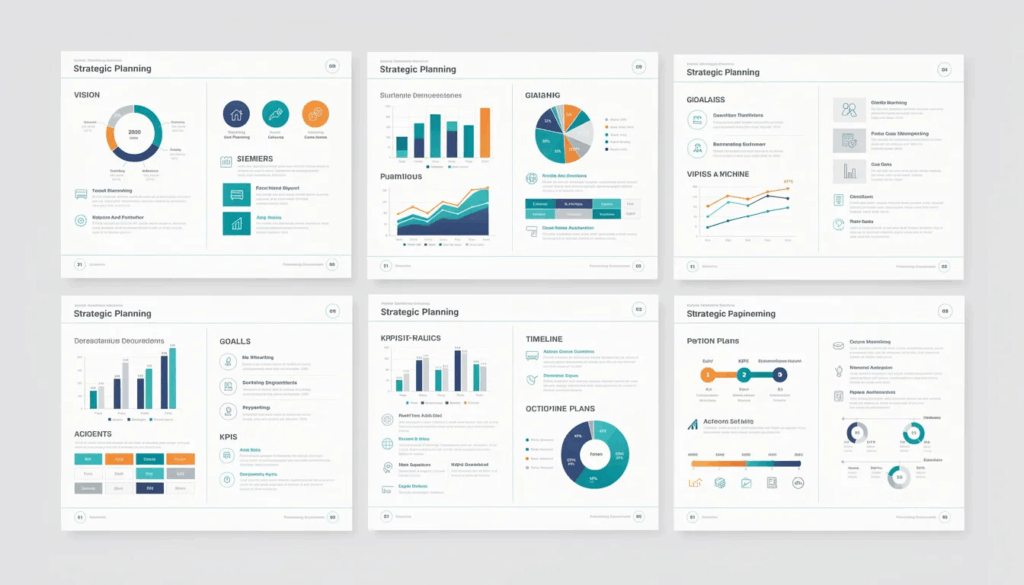
Present your implementation roadmap with clear timelines, responsibility assignments, and resource requirements. Consider using visual elements such as Gantt charts or milestone timelines that make complex implementation schedules easily understandable. Include accountability mechanisms and review processes that demonstrate your commitment to plan execution.
Design for Accessibility
Use clear formatting with consistent headings, bullet points, and white space that enhance readability and navigation. Many readers will reference specific sections rather than reading cover-to-cover, so ensure your document supports both comprehensive review and selective reference.
Include visuals such as charts, graphs, and infographics that illustrate key concepts and data points. Visual elements particularly help communicate complex information about program outcomes, financial trends, or implementation timelines. Ensure all visuals include clear captions and integrate seamlessly with surrounding text.
Keep your main document to 10-20 pages for external sharing while creating detailed appendices for internal use. External audiences including funders and community partners prefer concise documents that communicate key information efficiently. Internal appendices can include comprehensive data, detailed action plans, and technical information supporting plan development.
Step 7: Launch and Communicate Your Plan
Strategic plan launch and communication determine whether your planning effort results in meaningful organizational change or becomes another document gathering dust. Effective communication builds excitement, ensures understanding, and creates accountability for implementation across all stakeholder groups.
Internal Launch
Present your final strategic plan to the full board for formal approval and adoption. This presentation should review the planning process, highlight key strategic decisions, and secure explicit board commitment to plan implementation and oversight. Board approval creates the authority and accountability necessary for successful plan execution.
Share the complete plan with all staff members through presentations that explain strategic priorities, individual roles in implementation, and how daily work connects to strategic objectives. Staff buy-in requires clear understanding of how strategic initiatives affect their specific responsibilities and opportunities for professional growth. Consider department-level discussions that address implementation questions and concerns.
Communicate the strategic plan to active volunteers and key stakeholder representatives who participated in planning or provide ongoing organizational support. These stakeholders often become advocates for your strategic initiatives and may identify implementation opportunities or obstacles that leadership overlooks.
External Communication
Create condensed versions tailored for different external audiences including funders, donors, community partners, and program participants. Foundation and government funders often prefer strategic plan summaries that emphasize measurable outcomes and organizational capacity. Individual donors may respond better to narrative versions that highlight mission impact and community benefits.
Update your website and marketing materials to reflect your new strategic direction and priorities. Ensure consistency between your strategic plan content and external communications about programs, goals, and organizational vision. This alignment demonstrates organizational coherence and commitment to strategic implementation.
Announce your strategic plan publicly through newsletters, social media channels, and press releases that generate community awareness and support. Public announcements create external accountability for plan implementation while potentially attracting new supporters who share your strategic vision.
Step 8: Monitor Progress and Maintain Accountability
Strategic plan implementation requires systematic monitoring and accountability mechanisms that keep your organization focused on strategic priorities amid daily operational demands. Effective monitoring systems provide early warning about implementation challenges while celebrating progress that maintains momentum.
Regular Review Schedule
Establish monthly leadership team check-ins focused on tactical progress toward strategic objectives. These brief meetings should review action item completion, identify implementation obstacles, and make necessary adjustments to timelines or approaches. Keep meetings focused on strategic priorities rather than general operational issues.
Provide quarterly board reports that include key metrics updates, milestone achievements, and strategic initiative status. Board reports should highlight both successes and challenges while recommending specific actions needed to maintain implementation momentum. Use consistent reporting formats that enable board members to track progress trends over time.
Conduct annual comprehensive reviews that assess overall progress against strategic objectives and consider whether targets require adjustment based on changing circumstances. Annual reviews provide opportunities to add new initiatives, modify existing objectives, or reallocate resources based on implementation experience and environmental changes.
Schedule mid-plan evaluation at the 2-3 year mark to consider major revisions based on significant internal or external changes. This evaluation may recommend substantial plan modifications if organizational capacity, community needs, or external environment have shifted dramatically since plan development.
Accountability Systems
Use dashboard tools to track key performance indicators in real-time, providing constant visibility into strategic implementation progress. Effective dashboards highlight both leading indicators that predict future success and lagging indicators that measure ultimate outcomes. Consider cloud-based tools that enable remote access and collaborative updating.
Integrate strategic priorities into annual staff performance reviews, ensuring individual goals align with organizational strategic objectives. This integration creates personal accountability for strategic implementation while helping staff understand how their work contributes to broader organizational success.
Include strategic plan updates in every board meeting agenda, maintaining regular focus on implementation progress and strategic decision-making. Board engagement in ongoing strategic oversight prevents plans from becoming irrelevant while ensuring governance leadership remains connected to organizational direction.
Create a strategic plan implementation committee comprising board and staff representatives responsible for maintaining implementation momentum between formal review cycles. This committee can troubleshoot implementation challenges, recommend resource reallocations, and coordinate cross-departmental initiatives that span multiple strategic pillars.
Common Challenges and How to Overcome Them
Even well-designed strategic plans face predictable implementation challenges that can derail progress if not addressed proactively. Understanding these common obstacles enables nonprofit leaders to develop prevention strategies and quick responses when problems emerge.
Challenge: Plan sits on shelf unused Many strategic plans become forgotten documents that fail to influence daily decision-making or resource allocation. This typically occurs when plans are too complex, lack clear implementation steps, or aren’t integrated into regular organizational operations.
Solution: Embed strategic priorities into regular operations and meetings by including strategic updates in every staff meeting and board meeting agenda. Create simplified reference documents that staff can easily use for decision-making. Establish monthly check-ins specifically focused on strategic implementation progress.
Challenge: Too many priorities Organizations often develop strategic plans with numerous objectives that overwhelm implementation capacity and dilute focus. Attempting to accomplish everything simultaneously usually results in minimal progress on any initiative.
Solution: Limit your strategic plan to 3-5 pillars maximum and prioritize ruthlessly based on mission impact and organizational capacity. Consider phasing implementation over multiple years rather than attempting concurrent launch of all initiatives. Use objective criteria for priority ranking when difficult decisions arise.
Challenge: Lack of stakeholder buy-in Strategic plans fail when key stakeholders don’t understand, support, or feel ownership in strategic priorities. This often results from insufficient engagement during the planning process or poor communication during plan launch.
Solution: Involve key stakeholders in the planning process from the beginning rather than seeking input only after decisions are made. Use multiple communication methods to ensure all stakeholder groups understand strategic priorities and their roles in implementation. Create feedback mechanisms that enable ongoing stakeholder engagement throughout implementation.
Challenge: Unrealistic goals Overly ambitious objectives that exceed organizational capacity or ignore environmental constraints create frustration and abandonment of strategic initiatives. Unrealistic goals often reflect insufficient research or analysis during plan development.
Solution: Ground all objectives in comprehensive research data and honest assessment of organizational capacity. Include external expertise in goal-setting discussions to provide realistic perspective on achievability. Build in regular review cycles that enable goal adjustment based on implementation experience.
Challenge: External environment changes Significant external changes such as economic downturns, policy modifications, or community demographic shifts can make strategic plans obsolete if they’re treated as fixed documents rather than flexible frameworks.
Solution: Treat your strategic plan as a living document that evolves with changing circumstances through annual updates and environmental scanning. Build flexibility into implementation approaches while maintaining focus on core strategic priorities. Establish trigger points that indicate when major plan revisions may be necessary.
Strategic Planning Tools and Templates
Effective strategic planning relies on proven tools and templates that streamline the planning process while ensuring comprehensive coverage of essential elements. These resources help maintain planning quality while reducing the time and effort required for plan development.
SWOT Analysis Worksheet
A structured SWOT analysis worksheet guides systematic evaluation of internal strengths and weaknesses alongside external opportunities and threats. Include specific prompting questions for each category:
Strengths: What does your organization do exceptionally well? What unique resources or capabilities do you possess?
Weaknesses: Where does your organization struggle? What capabilities or resources are you lacking?
Opportunities: What external trends or changes could benefit your organization? What unmet community needs align with your mission?
Threats: What external factors could negatively impact your organization? What competitive or environmental challenges do you face?
Mission and Vision Statement Templates
Mission statement development templates help articulate why your organization exists, what you’re trying to accomplish, and how you differ from other organizations. Effective mission statements typically address target populations served, primary services or programs provided, and intended outcomes or impact achieved.
Vision statement templates guide creation of inspiring descriptions of the future you aim to create when your mission is fully realized. Strong vision statements paint a picture of community transformation that motivates stakeholders and provides direction for strategic planning.
Stakeholder Mapping Tools
Stakeholder mapping and engagement planning tools help identify all relevant stakeholder groups and design appropriate engagement strategies for each group. Consider stakeholders’ influence levels, interest in your work, and preferred communication methods when designing engagement approaches.
Map stakeholders across categories including board members, staff, volunteers, donors, community partners, program participants, and community members. For each group, identify key representatives, preferred engagement methods, and critical feedback needed for strategic planning.
OKR Tracking Spreadsheet
Objectives and Key Results tracking spreadsheets provide structured formats for monitoring progress toward strategic goals. Include columns for objective descriptions, key result metrics, target values, current status, responsible parties, and update dates.
Build formulas that automatically calculate completion percentages and highlight areas requiring attention. Consider conditional formatting that uses color coding to provide at-a-glance status visibility across multiple objectives and key results.
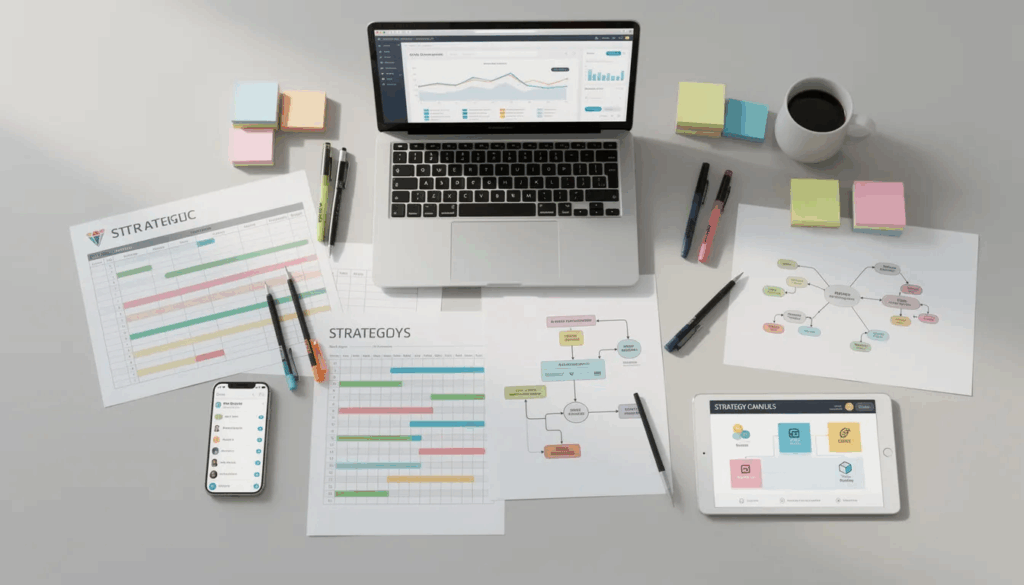
Implementation Timeline Template
Strategic plan implementation timeline templates help organize complex project sequences with dependencies, milestones, and responsibility assignments. Use Gantt chart formats or milestone tracking approaches that clearly communicate project relationships and critical path requirements.
Include buffer time for unexpected delays and decision points where implementation approaches may require adjustment based on early results or changing circumstances.
When to Update Your Strategic Plan
Strategic plans require regular updates to remain relevant and useful for organizational guidance. Understanding when and how to update your plan ensures it continues serving as an effective tool for decision-making and accountability throughout its intended timeframe.
Regular Update Cycles
Conduct full strategic planning cycles every 3-5 years with comprehensive stakeholder engagement, environmental assessment, and plan development processes. This timeframe allows sufficient time for strategy implementation while preventing plans from becoming outdated due to changing internal or external circumstances.
Perform annual reviews to update key results, adjust timelines, and add new initiatives that emerge from implementation experience or changing opportunities. Annual updates should modify specific tactics and targets while maintaining core strategic priorities unless significant changes warrant more substantial revisions.
Emergency Updates
Make emergency updates during major crises, significant leadership changes, or external disruptions that fundamentally alter your organization’s operating environment. These updates may require abbreviated planning processes that focus on immediate adaptation while preserving long-term strategic direction when possible.
Consider emergency updates when funding sources change dramatically, key partnerships dissolve, regulatory requirements shift substantially, or community demographics transform in ways that affect service demand or delivery approaches.
Continuous Monitoring Approach
Treat your strategic plan as a living document that evolves continuously with your organization rather than a static blueprint that remains unchanged throughout its lifespan. This approach requires ongoing environmental scanning, regular stakeholder feedback collection, and systematic assessment of implementation progress.
Signs indicating need for new strategic planning include completion of major objectives ahead of schedule, significant environmental changes affecting your mission area, leadership transitions that bring new vision or priorities, or persistent implementation challenges suggesting fundamental strategic misalignment.
Successful strategic planning for nonprofit organizations creates organizational alignment, guides resource allocation decisions, and provides accountability mechanisms that advance mission impact. Your strategic plan should inspire action while providing practical guidance for navigating complex decisions and competing priorities.
The eight steps outlined in this guide provide a comprehensive framework for developing and implementing strategic plans that transform nonprofit vision into measurable community impact. Remember that strategic planning represents an ongoing organizational capability rather than a one-time event – investing in strategic planning processes strengthens your organization’s ability to adapt, grow, and maximize mission advancement in an ever-changing environment.
Begin your strategic planning journey by assembling your planning team and committing to the systematic process that will define your organization’s trajectory for years ahead. The communities you serve deserve the focused impact that results from thoughtful strategic planning and disciplined implementation.
Frequently Asked Questions
How long should a nonprofit strategic plan be?
Most effective plans run 10 to 20 pages. Keep it concise enough that board members and staff will actually read it. Include your mission, vision, 3-5 strategic goals with measurable objectives, an implementation timeline, and budget projections. Lengthy plans tend to sit on shelves.
How often should a nonprofit update its strategic plan?
Review progress quarterly and do a formal refresh every 3 to 5 years. If your organization experiences a major shift like leadership change, significant funding loss, or a new program area, revisit the plan sooner. Annual check-ins let you adjust tactics without rewriting the whole document.
Do we need a consultant to create a strategic plan?
Not always. Small nonprofits with engaged boards can run the process internally using free templates and frameworks. A consultant adds value when you need an outside perspective, when internal politics make facilitation difficult, or when your board lacks strategic planning experience. Budget $5,000 to $25,000 for a facilitated process.
What is the biggest mistake nonprofits make during strategic planning?
Setting too many goals. Organizations that try to pursue 10 or more strategic priorities end up spreading resources too thin and making meaningful progress on none of them. Pick 3 to 5 goals that truly matter, then go deep on execution rather than wide on ambition.
How do we get staff buy-in on a new strategic plan?
Include staff in the process from the start. Run surveys, hold listening sessions, and invite front-line team members to planning workshops. People support plans they helped shape. After adoption, connect each team member’s work to specific plan goals so they see how their role drives the mission forward.