
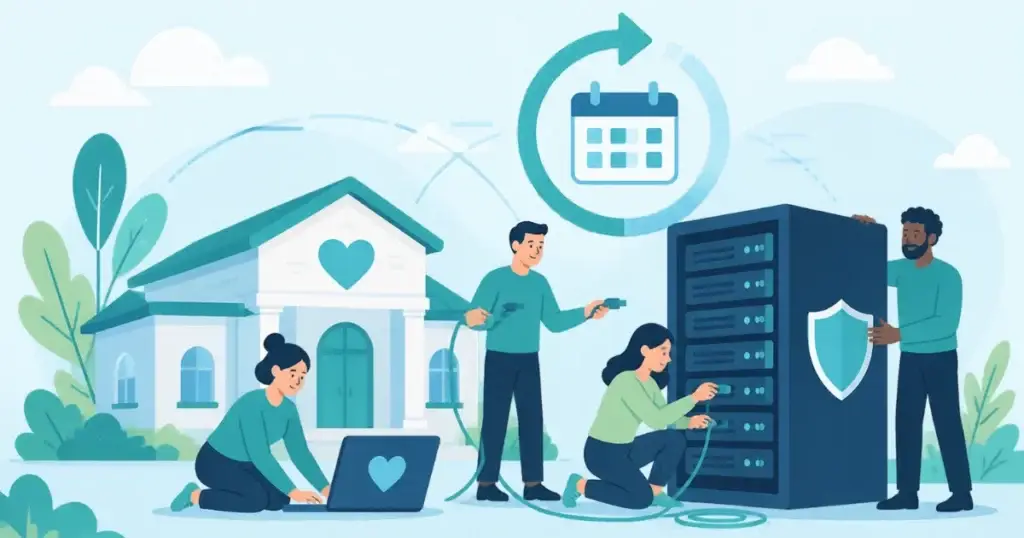
- How long does it take a nonprofit to recover from a cyberattack?
- What did the Albert Heijn cyberattack show about real recovery time?
- What are the phases of cyberattack recovery?
- What slows down recovery for a nonprofit?
- How long does ransomware recovery take compared with other attacks?
- What should a nonprofit do in the first 72 hours after a cyberattack?
- How much does it cost to recover from a cyberattack?
- Who can help a nonprofit recover from a cyberattack?
- Sources and further reading
- How long would your own nonprofit take to recover?
The question after any incident is how long does it take to recover from a cyberattack, and the honest answer is days to restore core operations and weeks to months for full recovery. The spread depends on clean backups, a written response plan, and how far the attacker got.
Scottship Solutions advises US nonprofits on cybersecurity and managed IT services for nonprofits. This guide uses named, dated survey data and the Albert Heijn incident to show the phases of recovery and the factors that stretch each one.
Will Facques, Senior IT Consultant (PMP, CompTIA Network+), wrote this guide. Every figure in it is attributed to the group that published it, and the survey figures skew toward large organizations, so the guide says where they stop applying to a nonprofit.
Wondering how long your own recovery would take? A nonprofit tech stack audit reviews your systems for inefficiencies, security gaps, and cost savings, so you can see the gaps that would slow a recovery. Tell us which systems and backups you run.
How long does it take a nonprofit to recover from a cyberattack?
A nonprofit recovers on three clocks. Operational recovery, when core systems run again, takes days. Full recovery, when every system, data set, and process is back to normal, takes months. Trust recovery, when donors, clients, and funders are confident again, takes longer still.
Leaders plan for the first clock and get surprised by the other two. Each survey below defines “recovered” in its own way.
| Source | Year | Finding | What it measures |
|---|---|---|---|
| Sophos, State of Ransomware | 2025 | 53% recovered within a week | Time to recover from ransomware (Sophos’s own definition) |
| Absolute Security survey | 2026 | 57% averaged more than 4.5 days, 19% took as long as two weeks | Full remediation and recovery, average time per incident (750 US and UK CISOs) |
| Fastly survey, reported by Infosecurity Magazine (19 Nov 2024) | 2024 | Average full recovery of 7.34 months, against 5.85 months predicted | Full recovery, not first restoration |
| Fastly survey, reported by Infosecurity Magazine (19 Nov 2024) | 2024 | Organizations planning to cut security spend expected 8.14 months and took 10.88 | Full recovery for organizations cutting security budgets |
The surveys disagree because they ask different questions of different organizations. Sophos reports 53% of ransomware victims recovered within a week, while Absolute reports 57% needing more than 4.5 days for full remediation and recovery. Read them as separate measurements, not one distribution.
Organizations also underestimate the long clock. In the Fastly survey, respondents predicted 5.85 months for full recovery and the average actual figure was 7.34 months.
What did the Albert Heijn cyberattack show about real recovery time?
Albert Heijn, the Dutch supermarket chain, switched off part of its IT systems on October 11, 2026, according to nltimes.nl, dutchnews.nl, and just-food.com reports published October 13 to 23, 2026. Downtime after a cyberattack of this kind showed up first on the shelves, where fresh produce ran out.
| Date (2026) | What was reported |
|---|---|
| October 11 | Part of the IT systems switched off |
| Following days | Fresh-produce shelves empty in stores |
| About October 13 | Restocking begins |
| October 18 to 19 | Website and app back online |
| October 19 | Police report filed |
| October 23 | Home deliveries resumed at about one third of normal logistics capacity |
| October 28 | Normal capacity expected |
That is about 12 days from shutdown to the return of home deliveries, which restarted at about one third of normal capacity, with normal capacity expected by October 28. Experts estimate EUR 120 to 150 million in lost revenue, according to NL Times. Albert Heijn has not confirmed that figure.
Translate 12 days to a nonprofit as an illustration. Case notes and client records sit out of reach, a payroll run slips, the donation page stops taking gifts, and a grant report due that week goes late.
What are the phases of cyberattack recovery?
NIST and CISA incident response guidance covers the same ground, though each groups and names the steps differently. This guide uses four plain-language phases: contain, eradicate, restore, and review. The incident response timeline for a nonprofit follows that order, and each phase ends in a decision that belongs to leadership. No phase has a fixed length, because the length depends on the factors in the next section.
Contain. The goal is to stop the spread by isolating affected devices and accounts. The decision at this point is who has authority to take systems offline, including systems staff need to serve clients.
Eradicate. Responders remove the attacker’s access and the malicious files, and reset credentials. The decision is whether to clean existing systems or rebuild them, and a compromised backup pushes that choice toward a rebuild.
Restore. Systems return in priority order from clean backups. The decision is the order itself: client services and payroll first, or donor systems first, and your cyber insurance carrier sets conditions before any restore begins.
Review. The team documents what happened, closes the gap the attacker used, and reports to the board and funders. The decision is which fixes get budget, and the review shortens recovery the next time.
What slows down recovery for a nonprofit?
Recovery slows when something between the attack and the restore is missing. Backups that were never tested, or that the attacker reached, force a rebuild from scratch. Read the breakdown of disaster recovery vs data backup before an incident, because a copy of your files is not a tested way to bring them back.
Four more gaps add days or weeks:
- No written response plan. Decisions get made under pressure, one at a time, with no agreed owner.
- Limited or outsourced IT staff. One or two people carry containment and restoration at once, and an outside provider needs time to get access.
- Unknown vendor dependencies. A system nobody remembers, such as a donor database host or a payment processor, comes back last because nobody knew to restore it.
- Carrier requirements. Cyber insurance carriers set conditions that must be satisfied before restoring, and skipping them puts the claim at risk.
Nonprofit obligations add calendar time on top. You notify affected donors and clients, notify the board, and report to funders under grant terms. Guidance on protecting donor data from breaches covers what to have ready before notification starts.
How long does ransomware recovery take compared with other attacks?
Ransomware recovery is the hardest tier, because the attacker locks the systems you need to recover with. The Sophos 2025 figure above comes from ransomware victims: 53% were recovered within a week. The question of how long it takes to recover from a ransomware attack still has two answers, one for first restoration and a longer one for full recovery.
Data breach recovery time follows a different shape. In a breach, data is copied rather than locked, so breach recovery centers on investigation, notification, and legal and funder reporting, not on rebuilding systems.
Business email compromise recovery is shorter and narrower. The scope is one or a few mailboxes, and the work is resetting credentials, removing forwarding rules, and warning the contacts who received fraudulent messages. No survey above breaks out email compromise, so this comparison is qualitative.
What should a nonprofit do in the first 72 hours after a cyberattack?
The first 72 hours decide how much damage the attacker does and how clean the evidence is. This is a response checklist for when an incident is already under way, and it assumes nobody has a plan in hand. If you want to build the plan before an incident, start with this business continuity plan guide. Work through the checklist in order.
- Isolate affected systems. Disconnect infected devices from the network and Wi-Fi. Leave them powered on unless a responder says otherwise.
- Preserve evidence. Photograph ransom notes and error screens, and keep logs. Wiping a machine early destroys what responders and the carrier need.
- Call the cyber insurance carrier. Report the incident before restoring anything, and ask which response firms the policy requires.
- Reach a response professional. Use the carrier’s panel responder, an incident response firm, or your managed IT and cybersecurity advisor.
- Tell leadership. Brief the executive director and the board chair, and agree who speaks to staff, donors, and funders.
How much does it cost to recover from a cyberattack?
Published recovery cost figures come from large organizations. Use them as scale markers, not as a nonprofit budget.
| Source | Year | Average recovery cost | What it measures |
|---|---|---|---|
| Sophos, State of Ransomware | 2025 | $1.53M (excluding any ransom) | Recovery cost, down 44% from 2024 (enterprise-skewed, not nonprofit specific) |
| Sophos, State of Ransomware | 2024 | $2.73M | Recovery cost excluding ransom (enterprise-skewed, not nonprofit specific) |
| Absolute Security survey | 2026 | $2.5M | Average direct recovery cost (enterprise-skewed, not nonprofit specific) |
Nonprofit recovery cost depends on scope: how many systems were hit, whether backups held, and how long operations stopped. Downtime cost per day is the figure most leaders miss. When leadership asks how long you will be down, the next question is what each day costs, and that math is worth running before an incident.
Who can help a nonprofit recover from a cyberattack?
A nonprofit has three realistic options. Cyber insurance panel responders come with the policy, and the policy names who to call first. Incident response firms take the technical work end to end. Managed IT and cybersecurity advisors know your systems and vendors before the incident starts.
Searches for recovery services return enterprise vendors such as Kroll, Kyndryl, Dell, and Fenix24 first.
Scottship advises nonprofits on managed IT and cybersecurity, including the backup, vendor, and response-contact questions that decide how long recovery takes. Settling those questions before an incident gives the first clock fewer surprises.
Frequently Asked Questions
How long does it take a nonprofit to recover from a cyberattack?
Core operations return in days, and full recovery takes months. Sophos found 53% of ransomware victims recovered within a week in 2025, and Fastly’s survey reported an average of 7.34 months for full recovery. Trust with donors, clients, and funders takes longer than both.
How long does it take to recover from a ransomware attack?
The Sophos State of Ransomware 2025 survey found 53% of organizations recovered within a week. Absolute Security reported that 57% averaged more than 4.5 days for full remediation and recovery and 19% took as long as two weeks. Full recovery runs much longer than first restoration.
How much does it cost to recover from a cyberattack?
Sophos reported an average recovery cost of $1.53M (excluding any ransom) in 2025, down from $2.73M excluding ransom in 2024, and Absolute Security reported $2.5M in average direct recovery cost. All three figures are enterprise-skewed and not nonprofit specific. For a nonprofit, the cost depends on scope and on how many days operations stop.
What affects how long a cyberattack recovery takes?
Clean, tested backups, a written response plan, the size of your IT staff, a known list of vendor dependencies, and cyber insurance carrier requirements set the pace. Notification and funder reporting add calendar time. Scottship works with nonprofits on the backup and vendor questions in that list before an incident happens.
Who can help a nonprofit recover from a cyberattack?
Your cyber insurance carrier’s panel responders, an incident response firm, and a managed IT and cybersecurity advisor each handle part of recovery. Enterprise vendors such as Kroll and Kyndryl dominate search results for recovery services. Scottship advises nonprofits on managed IT and cybersecurity, including the backup, vendor, and response-contact preparation that shortens recovery.
Sources and further reading
- Sophos, The State of Ransomware 2025: 53% of victims recovered within a week, and average recovery cost of $1.53M (excluding any ransom), down 44% from 2024
- Sophos, The State of Ransomware 2024: average recovery cost of $2.73M excluding ransom
- Absolute Security, global cyber resilience survey press release (8 January 2026): 57% averaged more than 4.5 days for full remediation and recovery, 19% as long as two weeks, and average recovery cost of $2.5M
- Infosecurity Magazine, coverage of the Fastly survey, 19 November 2024: average full recovery of 7.34 months against 5.85 predicted
- DutchNews.nl, Albert Heijn begins restocking as hack traced to foreign servers, 13 October 2026: restocking and shelf shortages
- DutchNews.nl, Albert Heijn owner files police report over cyberattack, 20 October 2026: October 11 shutdown and October 19 police report
- NL Times, Albert Heijn files police report, 19 October 2026: website and app back online and police report
- NL Times, Cyberattack attempt cost Albert Heijn up to 150 million euros, experts say, 20 October 2026: expert estimate of EUR 120 to 150 million, not confirmed by Albert Heijn
- Just Food, Albert Heijn resumes online deliveries after cyber outage, 23 October 2026: deliveries resumed at about one third of normal capacity, normal capacity expected by October 28
- NIST, SP 800-61 Rev 3, incident response recommendations (April 2025): incident response guidance
- CISA, Incident and Vulnerability Response Playbooks: incident response guidance
How long would your own nonprofit take to recover?
The survey averages describe other organizations. Your number depends on your backups, your vendors, and who picks up the phone, and those are the questions to settle before an incident.
A technology audit for your nonprofit reviews your systems for inefficiencies, security gaps, and cost savings, including the security gaps that would slow a recovery. Send us your recovery questions.

Written by
Will Facques
Senior IT Consultant at Scottship Solutions
Will works directly with nonprofit and small business clients on infrastructure, managed services, and technology implementations. He translates complex technical requirements into practical solutions that actually get done.
Certifications
PMP (Project Management Professional) • Lean Six Sigma Yellow Belt • CompTIA Network+
Industries Served
Human Services, Healthcare & Community Health, Education & Youth Development, Faith-Based, Child Advocacy, Arts & Culture