
What You’ll Learn
- What Does Digital Transformation Actually Mean for Nonprofits?
- What Doesn’t Count as Digital Transformation?
- What Are the Three Stages of Nonprofit Digital Transformation?
- What Are the Four Pillars of a Successful Transformation?
- What Are the Most Common Nonprofit Transformation Mistakes?
- Where Should a Nonprofit Start?
- Frequently Asked Questions
- Your Next Steps
- Sources
What Does Digital Transformation Actually Mean for Nonprofits?
Digital transformation is one of the most overused phrases in technology, and one of the most misunderstood in the nonprofit sector. Vendors use it to describe cloud migrations. Consultants use it to describe software implementations. Board members use it to mean “we should probably do something with AI.”
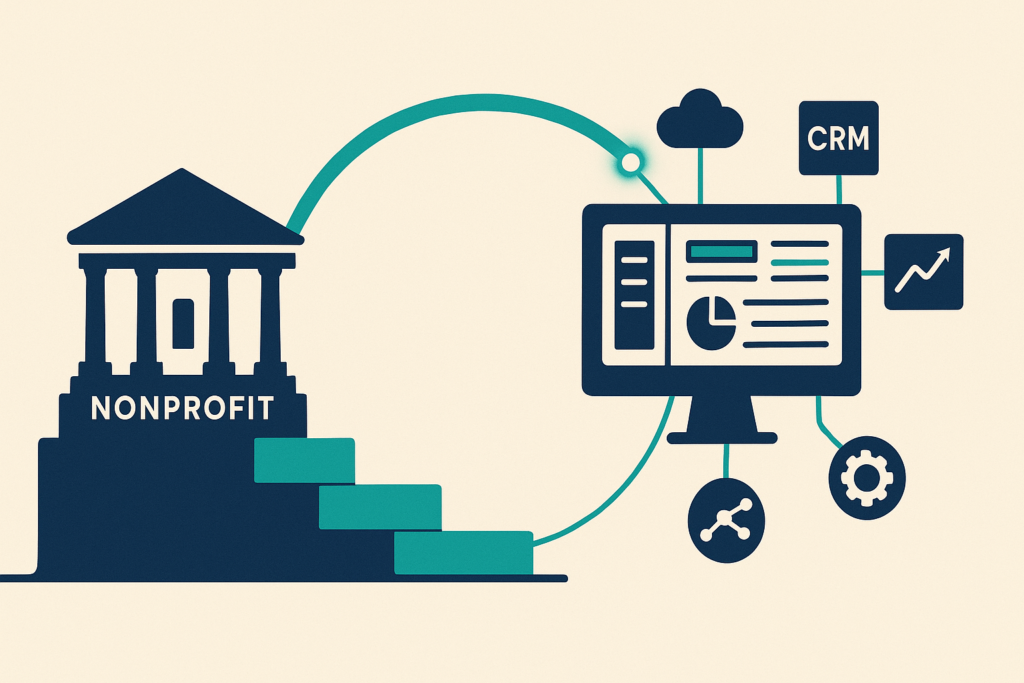
A working definition: digital transformation for nonprofits is the deliberate shift from operating on disconnected, manual, or outdated technology to a state where integrated digital systems actively enable mission delivery, and where the organization’s people and processes are aligned to use those systems effectively.
Three words in that definition do the most work:
Deliberate. Transformation that happens by accident, through reactive tool purchases and ad-hoc upgrades, is not transformation. It is technology debt accumulation with better branding. Real transformation follows a roadmap.
Integrated. The difference between an IT upgrade and digital transformation is integration. When your donor management system, financial system, program database, and communication tools share data and trigger automated workflows across each other, you have transformed operations. When they are separate tools your staff manually reconciles, you have a collection of software.
Aligned. Technology without process change delivers technology costs, not technology benefits. The hardest part of digital transformation is not the tools, it is getting the organization’s workflows, staff habits, and leadership expectations to match what the tools are capable of.
What Doesn’t Count as Digital Transformation?
Clarifying what transformation is not helps more than the definition, because most nonprofits are doing these things and calling it transformation:
It is not moving to the cloud. Migrating your email to Microsoft 365 or Google Workspace is infrastructure modernization. It is a necessary first step, but it is not transformation. The question transformation asks is what you do differently once you are in the cloud, not just where your data lives.
It is not buying a new CRM. Replacing Raiser’s Edge with Salesforce NPSP is a system migration. If your workflows, reporting, and staff practices look the same six months after go-live, you bought a new tool. You did not transform.
It is not an AI pilot. Having five staff members use ChatGPT on their own, for their own tasks, with no shared policy or workflow, is AI experimentation. Transformation means AI is embedded in specific organizational workflows with measurable outcomes.
It is not a one-time project. Digital transformation does not have a finish line. Organizations that approach it as a project, with a start date, an end date, and a go-live celebration, typically regress to their pre-transformation state within 18 months because they stopped investing in the capability to evolve.
What Are the Three Stages of Nonprofit Digital Transformation?
Nonprofits that successfully transform do not try to do everything at once. They move through three stages in sequence, and they do not rush Stage 1 to get to Stage 3.
Stage 1: Stabilize (Months 1 to 6). Fix the foundation before building anything on top of it. This means completing a technology audit to understand what you have, eliminating redundant tools and costs, migrating to a stable cloud platform, establishing security baselines (MFA, endpoint protection, backup), and ensuring your CRM data is clean and trustworthy. Organizations that skip Stage 1 invest in automation and AI on top of a broken foundation and wonder why the ROI never materializes.
Stage 2: Automate (Months 6 to 18). Once the foundation is stable, identify the highest-volume repetitive workflows and build automation around them. Donor acknowledgment emails that trigger automatically from CRM giving events. Grant deadline alerts that pull from a shared calendar. Meeting summaries generated by AI and distributed to relevant staff without manual effort. Board report templates that populate from live data rather than manual spreadsheet pulls. This is where staff time savings become real and measurable.
Stage 3: Optimize (Month 18+). With stable infrastructure and automated core workflows, the organization can shift to data-driven decision-making. Real-time dashboards that show program cost per participant, donor retention trends, and grant pipeline by funder. Predictive models that identify lapsed donors before they lapse. AI-assisted program design that incorporates outcome data from past cycles. Stage 3 is where transformation becomes a competitive advantage, not just operational efficiency.
What Are the Four Pillars of a Successful Transformation?
Across every successful nonprofit digital transformation Scottship has supported, four conditions are present. When one is missing, the transformation stalls.
Executive sponsorship. The Executive Director or a C-suite sponsor who has publicly committed to the transformation and is willing to make unpopular decisions, retiring beloved but obsolete tools, requiring staff to change workflows, allocating budget before ROI is proven. Without an executive sponsor, transformation committees stall and decisions never get made.
A technology roadmap. A prioritized, sequenced plan that connects technology decisions to organizational strategy. Not a list of tools to buy, but a document that shows where the organization is today, where it needs to be in 24 months, and the specific steps, in order, that close that gap. A Tech Stack Audit is the fastest way to produce this document.
Staff capacity for change. Every technology change requires staff to learn new workflows. Organizations that do not budget time for training, not just go-live day training, but sustained practice over 60 to 90 days, see adoption rates that make the investment worthless. Budget 10 to 15 hours per person in the first quarter for any significant system change.
Strategic technology leadership. Someone whose job is to think about technology direction, evaluate vendor options, manage implementations, and hold the vision of where the organization is going. For most nonprofits, a full-time CIO is not affordable. A Fractional CIO fills this role at a fraction of the cost, and brings cross-sector experience that an internal hire rarely matches.
What Are the Most Common Nonprofit Transformation Mistakes?
Buying tools before auditing what you have. The most expensive mistake. Organizations that purchase a new CRM, automation platform, or AI tool without first understanding what their current systems do and cost reliably create integration problems, duplicate costs, and staff confusion. A technology audit takes 2 to 4 weeks. A failed CRM migration takes 12 to 18 months to recover from.
Treating transformation as an IT project, not an organizational change project. Technology is 30% of transformation. Process redesign, staff adoption, and leadership alignment are the other 70%. Organizations that hand transformation to their IT person, or their IT vendor, and expect it to happen without active organizational leadership consistently underdeliver.
Trying to do everything in Year 1. The organizations that achieve the most in three years are the ones that did the least in Year 1, specifically, the ones that spent Year 1 stabilizing rather than building. Every hour spent in Stage 1 reduces the rework required in Stages 2 and 3.
Not measuring before and after. If you do not measure how long a workflow takes before automation, you cannot demonstrate that the automation worked. Every transformation investment should have a baseline metric and a target. Even a simple one: “This report currently takes 4 hours to produce. After implementation, it should take 20 minutes.”
Where Should a Nonprofit Start?
The single most valuable first step is a nonprofit tech stack audit. Before you buy anything, migrate anything, or automate anything, map what you have. A professional audit produces a prioritized roadmap in 2 to 4 weeks that answers three questions your leadership needs before any transformation investment: What do we currently have? What is it actually costing us? What should we change first?
The second step is establishing strategic technology leadership. Transformation without a technology strategist guiding it produces technology purchases without strategy. A Fractional CIO gives you CIO-level thinking without the full-time hire cost, and brings the cross-organization experience to avoid the mistakes that sink most transformation efforts.
The third step is picking one workflow to transform in the first 90 days, not twelve. One workflow, fully automated and proven, builds the organizational confidence and process muscle that makes every subsequent change easier.
Related guides: enterprise architecture for nonprofits and nonprofit tech stack audit.
Frequently Asked Questions
What is digital transformation for nonprofits?
Digital transformation for nonprofits is the process of replacing disconnected, manual, or outdated technology systems with integrated digital tools, and the organizational changes required to use them effectively. It is not a single project or a software purchase. It is a shift in how an organization delivers programs, manages donor relationships, reports on impact, and operates internally. For nonprofits, transformation typically unfolds in stages: stabilizing core infrastructure first, then automating repetitive workflows, then using data to make decisions in real time.
What is the difference between digital transformation and an IT upgrade?
An IT upgrade replaces a specific tool, a new CRM, a faster computer, a cloud email migration. Digital transformation is broader: it asks whether your technology as a whole enables your mission or constrains it, and then redesigns systems and workflows accordingly. Most nonprofits that call something a “digital transformation” are actually doing an IT upgrade. True transformation changes how work gets done, not just what tools people use to do it. The technology is the vehicle; the process and culture change is the destination.
How long does digital transformation take for a nonprofit?
A realistic digital transformation for a small-to-mid-size nonprofit (under 75 staff) takes 12 to 36 months from first audit to full operational integration. The most common mistake is treating it as a 90-day project. Phase 1 (infrastructure stabilization) typically takes 3 to 6 months. Phase 2 (workflow automation) takes 6 to 12 months. Phase 3 (data-driven operations) is ongoing. Organizations that try to compress the timeline by skipping Phase 1 consistently encounter the same problems at Phase 2 that they tried to leave behind.
How much does digital transformation cost for a nonprofit?
Costs vary widely by scope. A Phase 1 infrastructure audit and stabilization (covering tech stack audit, security baseline, and cloud migration) typically runs $10,000 to $30,000 for a nonprofit under 50 staff. Phase 2 automation implementation adds $5,000 to $25,000 depending on complexity. Many nonprofits significantly reduce these costs through Microsoft, Google, and Salesforce nonprofit grant programs that provide enterprise-grade tools at no cost. A Fractional CIO engagement, which guides transformation without the cost of a full-time hire, runs $2,000 to $5,000/month.
Where should a nonprofit start with digital transformation?
Start with a technology audit, not a technology purchase. Most nonprofits begin transformation by buying new tools before understanding what their current systems actually do, what they cost, and where the real gaps are. A tech stack audit maps your current state in 2 to 4 weeks and produces a prioritized roadmap, so your first investments go to the highest-impact changes rather than adding more tools to an already cluttered stack. See Scottship’s Tech Stack Audit for how this works in practice.
Does a nonprofit need a CIO to lead digital transformation?
Not a full-time one. Most nonprofits under 100 staff cannot justify a $150,000 to $200,000/year CIO salary, but they do need CIO-level strategic thinking to guide transformation. A Fractional CIO provides that leadership at a fraction of the cost, typically $2,000 to $5,000/month, and works alongside your existing team to set technology direction, evaluate vendors, manage migrations, and ensure transformation investments align with your strategic plan.
Your Next Steps
- Assess where your organization is in the three stages. Are you still in Stage 1 (unstable infrastructure, manual processes, data you don’t trust)? Be honest. Most nonprofits that think they’re in Stage 2 are still finishing Stage 1.
- Identify your biggest technology constraint. What single technology problem, if solved, would have the most impact on staff time or mission delivery? That is your starting point, not the most exciting opportunity, but the most constraining bottleneck.
- Commission a tech stack audit. Before any investment, map what you have. Scottship’s Tech Stack Audit takes 2 to 4 weeks and produces a prioritized roadmap your leadership can act on immediately.
- Evaluate your technology leadership gap. Does your organization have someone whose job includes technology strategy, vendor evaluation, and transformation oversight? If not, a Fractional CIO engagement fills that gap at a fraction of a full-time hire cost.
- Contact Scottship Solutions, we will assess your current stage, identify the one change likely to make the biggest difference, and tell you honestly whether you need an audit, a Fractional CIO, or both.
Sources
- NTEN, Nonprofit Technology Enterprise Network: annual nonprofit technology adoption research
- Salesforce.org, Nonprofit Trends Report, 5th Edition (2024)
- McKinsey & Company, Digital transformation success factors and failure modes
- TechSoup, Nonprofit technology resources and discount programs

Written by
Parker Davis
System Architect at Scottship Solutions
Parker works hands-on with nonprofit and small business leaders on IT strategy, cybersecurity, AI implementation, and cloud architecture. He leads the work at Scottship Solutions that helps mission-driven organizations build reliable, secure technology infrastructure.
Certifications
IBM AI Product Manager • Lean Six Sigma Yellow Belt • TOGAF Standard • Claude Certified Architect
Industries Served
Human Services, Healthcare & Community Health, Arts & Culture, Education & Youth Development, Faith-Based, Foundations & Grantmakers, Child Advocacy