
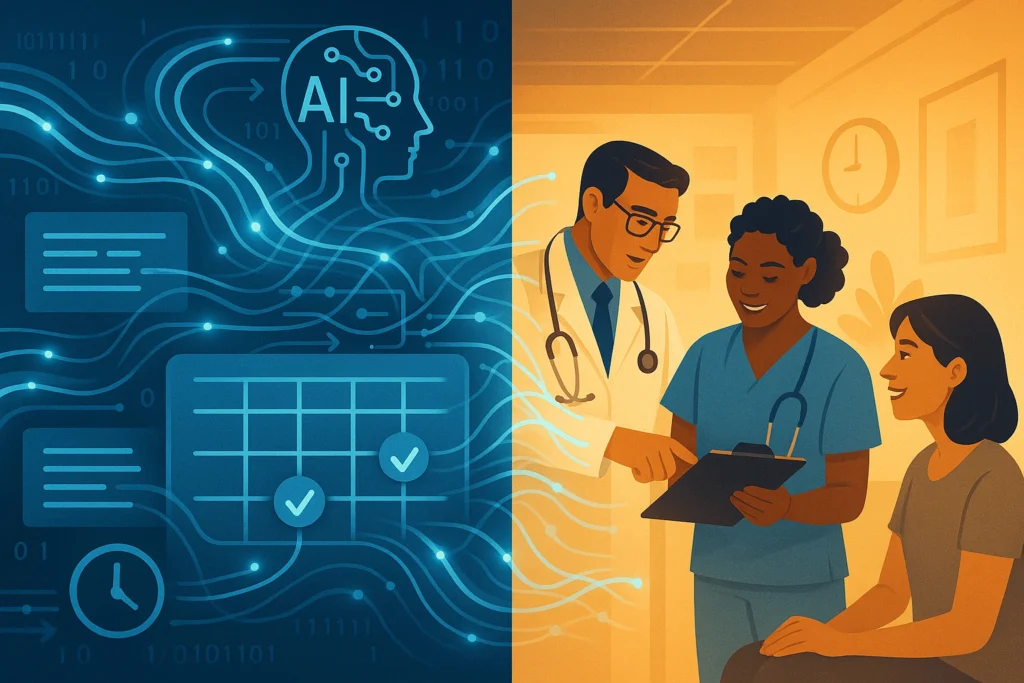
TL;DR: The strongest patient scheduling setups pair AI with human staff instead of choosing one over the other. AI covers 24/7 self-scheduling, dynamic rescheduling, and routine confirmations, while human staff manage complex cases and the personal relationships that care depends on. Scottship Solutions helps nonprofit healthcare practices design that hybrid balance.
The healthcare industry sits at a crossroads over patient scheduling, a pivotal moment for the entire healthcare sector. As healthcare stands at a critical inflection point, AI is transforming healthcare by streamlining processes, improving accuracy, and enhancing patient experiences. Artificial Intelligence (AI) refers to the science and engineering of making intelligent machines through algorithms. AI can analyze vast amounts of medical data to provide accurate diagnoses and support clinical decision-making processes. With AI technology advancing rapidly and patient expectations evolving, healthcare practices face a critical decision: should they rely on artificial intelligence, human staff, or find the perfect balance between both approaches?
The answer isn’t as straightforward as you might think. Each approach brings unique strengths to your practice, and the most successful healthcare organizations are discovering that the real magic happens when you combine the best of both worlds. Healthcare leaders play a vital role in guiding these changes, ensuring responsible and effective integration of AI into clinical workflows.
What Can AI-Powered Patient Scheduling Systems Do?
AI scheduling systems are reshaping how healthcare practices manage appointments, offering capabilities that extend far beyond basic calendar management. These intelligent systems provide 24/7 self-s
One of the most useful features of AI scheduling is dynamic appointment management. With advanced AI, these systems streamline clinical workflows by automatically adjusting schedules in real time. When cancellations occur, these systems immediately evaluate waiting lists, assess urgency levels, and consider provider availability to fill slots instantly. In addition, AI can automate administrative tasks and significantly reduce the burden of administrative tasks for staff, freeing up time for more patient-focused activities. Patient safety is a major concern when using AI in healthcare, necessitating accuracy in recommendations. AI also helps improve the accuracy of cancer diagnoses through tools that integrate into screening workflows.
AI scheduling systems can also improve patient safety by reducing scheduling errors and ensuring timely appointments.
Personalized Patient Matching
Modern AI systems go beyond simple date and time coordination. They consider clinical needs, language preferences, previous provider relationships, and patient-specific factors like work schedules to connect patients with the most appropriate healthcare providers. By drawing on clinical data, AI supports clinical decision-making and enables the creation of personalized treatment plans tailored to each patient’s unique needs. AI analyzes patient histories and genetic information to predict disease risk and progression. This sophisticated matching process ensures better patient outcomes and stronger provider-patient relationships. AI also plays a crucial role in advancing personalized medicine and precision medicine by improving patient-provider matching and enabling more individualized care. Additionally, AI is expected to aid in predicting disease progression by detecting subtle warning signals in patient data.
Addressing Healthcare Accessibility
AI scheduling systems excel at addressing healthcare disparities by offering accessibility features that human staff might overlook. These include:
• Adjusted clinical hours for underserved populations
• Transportation assistance coordination for rural communities
• Multilingual interfaces for diverse patient populations
• Digital navigation assistance for patients with limited technical experience, with a strong emphasis on protecting patient data and health data to ensure privacy and compliance with regulations.
• Appointment suggestions that align with public transit schedules
Additionally, AI scheduling systems can integrate with electronic health records and health records to further enhance accessibility and continuity of care.
Why Are Human Schedulers Still Essential?
While AI brings impressive capabilities to patient scheduling, human schedulers offer qualities that technology simply cannot replicate. The empathy, critical thinking, and personalized communication that human staff provide remain essential for maintaining strong patient relationships. Healthcare professionals, medical professionals, and healthcare workers play a crucial role in delivering personalized scheduling and care, ensuring that each patient’s needs are met with expertise and compassion.

Human schedulers excel at navigating complex scenarios that don’t fit standard protocols. They can handle nuanced situations requiring flexibility, provide emotional support during stressful appointment scheduling, and offer personalized problem-solving that considers the full context of each patient’s unique circumstances.
Complex Problem Resolution
When patients face challenging scheduling situations, such as multiple specialist referrals, insurance complications, or urgent medical needs, human staff can think creatively and adapt solutions in real time. This critical thinking ability allows them to address problems that might stump even the most sophisticated AI system. By applying their expertise, human staff play a vital role in direct patient care and use their problem-solving skills to enhance patient care, ensuring that unique patient needs are met effectively.
AI vs Human Staff: Which Handles Scheduling Better?
Is a Hybrid Model the Best Scheduling Strategy?
The most successful healthcare practices aren’t choosing between AI and human staff. They’re strategically combining both approaches to maximize efficiency while preserving the personal touch that healthcare requires. Integrating AI into the healthcare system and across various health systems requires careful planning to ensure seamless adoption, technical compatibility, and stakeholder acceptance. However, integrating AI with existing IT systems can introduce additional complexity for medical providers. AI is expected to enable healthcare systems to achieve improved population health, better patient experience, enhanced caregiver experience, and lower healthcare costs.
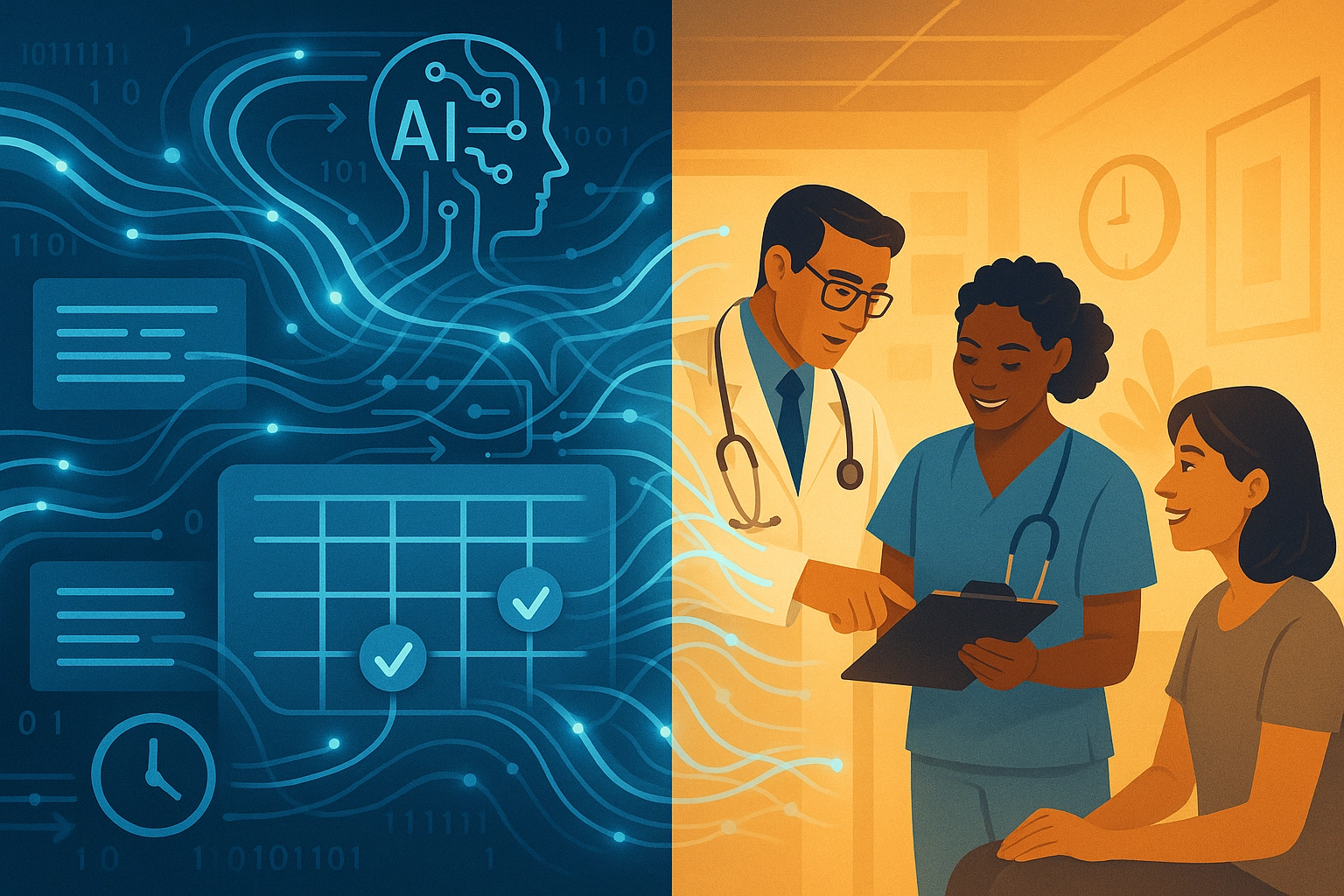
This hybrid model allows AI to handle repetitive tasks like basic appointment scheduling, routine confirmations, and straightforward rescheduling requests. It can be effectively applied in different clinical settings and clinical practice, supporting staff in hospitals, clinics, and other healthcare environments. Meanwhile, human staff focus their energy on complex patient needs, relationship building, and situations requiring emotional intelligence and creative problem-solving.
Benefits of the Combined Approach
Healthcare practices implementing hybrid scheduling models report significant improvements across multiple areas:
• Faster response times for all patient inquiries
• Reduced administrative costs while maintaining service quality, as healthcare artificial intelligence streamlines healthcare administration by automating scheduling, documentation, and other administrative processes
• Improved patient satisfaction through better accessibility and personalized care
• Enhanced staff productivity by eliminating routine, time-consuming tasks
• Better use of resources through intelligent scheduling optimization
AI models and AI algorithms play a crucial role in increasing the efficiency and effectiveness of hybrid scheduling systems by enabling accurate predictions, optimizing workflows, and supporting data-driven decision-making.
Which Scheduling Approach Fits Your Practice Type?
Small Practices with Limited Resources
If you’re running a smaller healthcare practice with budget constraints, start with AI-powered scheduling systems to handle routine appointments and basic patient inquiries. This approach allows you to maintain minimal human staff for complex cases while dramatically improving your scheduling efficiency and patient accessibility. AI can also draw on medical data and healthcare data to automate administrative tasks, such as appointment documentation and workflow optimization, further reducing staff workload and increasing operational efficiency.
Focus on implementing systems that offer strong self-service capabilities and can handle the majority of your standard appointment types without human intervention.
Large Healthcare Systems
For larger healthcare organizations, implement a comprehensive hybrid model where AI manages routine scheduling tasks, dynamic rescheduling, and resource optimization across multiple locations and specialties. In large systems, the adoption of AI in healthcare enables the use of advanced AI technologies and specialized AI models to streamline operations, enhance diagnostics, and improve overall efficiency at scale. Your human staff can then concentrate on complex patient coordination, relationship management, and high-value interactions that require personal attention.
This approach scales effectively across multiple departments and can significantly reduce administrative overhead while improving patient experience.
Specialty Practices
Specialty healthcare practices should use AI for initial appointment matching based on clinical specialization and provider expertise, while maintaining human oversight for detailed patient consultations and complex scheduling requirements that require deep medical knowledge. AI in specialty practices draws on clinical data to support medical research, enhance disease diagnosis, and analyze medical imaging, thereby improving patient outcomes and advancing healthcare innovation.
The AI system can handle the preliminary screening and matching, while human staff manage the nuanced aspects of specialist care coordination.
Practices Serving Diverse Communities to Improve Patient Outcomes
If your practice serves diverse populations, combine AI’s multilingual capabilities and accessibility features for initial patient access with culturally competent human staff for personalized care coordination. AI can also enable remote patient monitoring, improve patient safety, and help identify and manage health risks in diverse communities by providing real-time tracking, early detection of issues, and tailored interventions. This approach ensures that technology barriers don’t prevent patients from accessing care while maintaining cultural sensitivity in patient interactions.
How Do You Make the Transition to Hybrid Scheduling Work?
Successfully implementing a hybrid scheduling approach requires careful planning and gradual integration. Start by identifying which scheduling tasks consume the most staff time and have the highest volume. These are prime candidates for AI automation. Engaging stakeholders in the design and development of AI solutions ensures that the technology meets the actual needs of users. Train your human staff to work alongside AI systems rather than viewing them as replacements. The most effective approach treats AI as a “co-pilot” that makes human schedulers more productive and enables them to focus on higher-value activities that truly require human expertise. Modern AI scheduling solutions often use generative AI, deep learning, machine learning, and natural language processing to optimize workflows and enhance decision-making.

Train your human staff to work alongside AI systems rather than viewing them as replacements. The most effective approach treats AI as a “co-pilot” that makes human schedulers more productive and enables them to focus on higher-value activities that truly require human expertise. Modern AI scheduling solutions often use generative AI, deep learning, machine learning, and natural language processing to optimize workflows and enhance decision-making.
Monitor patient feedback closely during the transition period and be prepared to adjust the balance between AI and human involvement based on patient preferences and satisfaction scores. AI algorithms are continuously improved using data from clinical trials, healthcare research, and medical literature to ensure better outcomes and adaptability.
The future of healthcare scheduling is not a choice between AI and human staff. The strongest results come from an intelligent combination that delivers faster responses, reduced costs, improved patient satisfaction, and better use of resources while maintaining the essential human connection that healthcare requires.
Your practice can achieve remarkable improvements in efficiency and patient care by strategically implementing AI scheduling systems while preserving the irreplaceable value that skilled human staff bring to patient relationships and complex problem-solving scenarios. Looking ahead, AI scheduling systems have the potential to integrate with broader healthcare innovations, including drug discovery, drug development, medical devices, the ability to analyze medical images, and support for conditions such as breast cancer, in alignment with guidance from organizations like the World Health Organization. AI algorithms can also enhance drug discovery by predicting how different drugs will react in the body during clinical trials.
Frequently Asked Questions
Can AI handle patient scheduling without human staff?
Not on its own. AI is strongest at routine work like 24/7 self-scheduling, appointment confirmations, and straightforward rescheduling, while human staff handle complex cases, insurance complications, and the emotional support patients need. The most successful practices combine both. Scottship Solutions helps nonprofit healthcare practices design that hybrid balance.
What can AI scheduling systems do that human staff cannot?
AI scheduling systems offer round-the-clock self-scheduling, dynamic appointment management that fills canceled slots automatically, and personalized patient matching based on clinical needs and language preferences. They also add accessibility features such as multilingual interfaces, transportation coordination, and appointment suggestions that align with public transit schedules.
Which scheduling approach is right for a small practice?
Smaller practices with budget constraints should start with AI-powered scheduling to handle routine appointments and basic patient inquiries, keeping minimal human staff for complex cases. This improves scheduling efficiency and patient accessibility without a large administrative team.
How do you transition to a hybrid scheduling model?
Start by identifying the scheduling tasks that consume the most staff time and have the highest volume, since those are the best candidates for AI automation. Train staff to work alongside AI as a co-pilot, then monitor patient feedback and adjust the balance between AI and human involvement based on satisfaction scores.

Written by
Isabela Guimaraes
AI Consultant at Scottship Solutions
Isabela helps nonprofits and small businesses implement practical AI and automation solutions. She translates emerging AI capabilities into workflows that save time and expand mission impact.
Certifications
AWS Certified AI Practitioner • AWS Certified Cloud Practitioner • Google Cloud Generative AI Leader
Industries Served
Human Services, Healthcare & Community Health, Education & Youth Development, Child Advocacy