What You’ll Learn
- What Does Process Optimization Actually Mean for Nonprofits?
- Why Do Nonprofit Processes Break Down?
- What Are the Five Steps of the Process Optimization Framework?
- Which Nonprofit Processes Should You Optimize First?
- What Does Process Optimization Deliver?
- When Should You Automate vs. Optimize?
- Frequently Asked Questions
- Your Next Steps
- Sources
What Does Process Optimization Actually Mean for Nonprofits?
Process optimization is the practice of systematically examining how work flows through your organization, identifying where it breaks down, and redesigning it to work more reliably, with less staff time, fewer errors, and less dependence on any one person’s knowledge.
For nonprofits, the most common targets are operational workflows: how a donation moves from receipt to acknowledgment, how a new volunteer gets from application to first shift, how a grant gets from opportunity identification to submission to reporting. These are the processes that run most frequently and create the most friction when they fail.
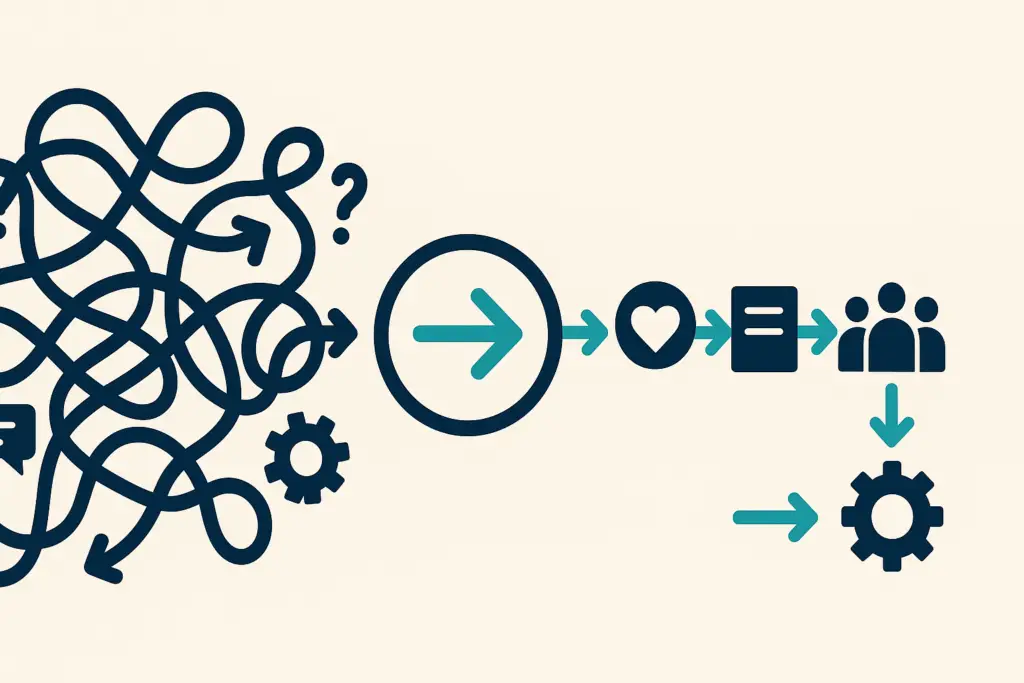
The distinction that matters: process optimization is not about buying software. It is about understanding how work actually flows, as opposed to how it is theoretically supposed to flow, and redesigning it before layering technology on top. Software applied to a broken process makes the process fail faster. Process optimization precedes automation.
According to a McKinsey analysis of organizational efficiency, organizations that document and optimize core processes before implementing new technology see 2 to 3x better outcomes from technology investments than those that implement technology first and try to work process improvement in afterward.
Why Do Nonprofit Processes Break Down?
The three root causes of process failure at nonprofits are consistent across organizations of every size:
Key-person dependency. Critical processes exist only in one person’s head, the development director who knows the full grant submission checklist, the operations coordinator who is the only person who knows how to run payroll in the current system, the program manager whose onboarding process for new participants is entirely improvised. When that person is unavailable, on vacation, or leaves the organization, the process fails or stops entirely.
Undocumented decision points. Most processes have branches, if X happens, do Y; if Z happens, escalate to the ED. When these decision points are not documented, each person who handles the workflow makes different decisions based on their own interpretation, producing inconsistent outcomes. Donor complaints, grant reporting errors, and volunteer experience inconsistencies almost always trace back to undocumented decision branches.
Process drift. Processes are documented once and then drift as staff develop workarounds, tools change, or new requirements are added informally. The documented process and the actual process diverge over time. When the documented process is wrong, documentation becomes a liability rather than an asset, new staff follow the documentation and produce different results than experienced staff who know the actual workflow.
What Are the Five Steps of the Process Optimization Framework?
Scottship Solutions uses a five-step framework for nonprofit process optimization engagements. The steps must be done in sequence, skipping Step 2 (current-state mapping) is the most common mistake, and it consistently produces documentation that no one follows because it does not reflect how work actually gets done.
Step 1: Process Inventory. Identify all significant recurring workflows in the organization. For most nonprofits, this surfaces 15 to 30 processes across fundraising, program delivery, finance, HR, and operations. Prioritize them by frequency, staff time consumed, error rate, and key-person risk. This step takes one to two weeks and produces the optimization roadmap.
Step 2: Current-State Mapping. Document how each priority process actually works today, through interviews with the people who do the work, not the people who manage it. Current-state maps capture every step, every decision point, every tool used, every handoff between people, and every exception that staff handle informally. This is the most revealing step: it consistently surfaces waste, duplication, and key-person knowledge that leadership did not know existed.
Step 3: Gap Analysis. Identify where the current process creates problems: steps that take longer than they should, decision points where staff consistently make different choices, handoffs that regularly fail, exceptions that require escalation, and steps that depend entirely on one person’s knowledge. The gap analysis translates observations into a prioritized list of improvements with estimated impact.
Step 4: Future-State Design. Redesign the process: eliminate unnecessary steps, standardize decision criteria, clarify handoffs, remove key-person dependencies, and design the workflow so it produces consistent results regardless of who executes it. Future-state design includes a written process document (step-by-step instructions), a visual workflow map, a RACI matrix (who is Responsible, Accountable, Consulted, Informed for each step), and the tools or templates required.
Step 5: Implementation, Training, and Testing. Roll out the new process with the team: training sessions, parallel operation (running old and new processes simultaneously to catch gaps), a feedback period of 30 to 60 days, and a documented review cycle. Processes that skip formal implementation consistently revert to the old workflow within 90 days because staff default to familiar patterns under pressure.
Which Nonprofit Processes Should You Optimize First?
Not all processes are equally worth optimizing. The highest-value targets share three characteristics: they occur frequently, they have measurable consequences when they fail, and they currently depend on individual knowledge rather than documented procedures.
Donor acknowledgment and stewardship. Research from Bloomerang and Fundraising Effectiveness Project consistently shows that how quickly and personally a nonprofit acknowledges gifts is one of the strongest predictors of donor retention. A process that takes 3 to 5 days to send an acknowledgment loses donors that a 24 to 48-hour process retains. This is high-frequency, directly revenue-impacting, and usually dependent on one development staff member’s workflow.
Grant management. From opportunity identification through reporting, grant processes are where key-person dependency creates the most organizational risk. A missed deadline or incomplete report costs more than the grant was worth. Nonprofits that have lost grants due to process failures, missed attachments, wrong template versions, reporting gaps, consistently trace the failure to undocumented decision points and unclear ownership.
Volunteer onboarding. Volunteer first-shift experience directly affects whether they return and refer others. Onboarding processes that vary by coordinator produce wildly different volunteer experiences. Standardizing the onboarding workflow, confirmation, orientation, first-day preparation, follow-up, produces measurably better retention rates at almost every organization that implements it.
Monthly financial close and reporting. How long it takes to produce financial reports for the board is one of the most reliable signals of operational process maturity. Organizations where the monthly close takes more than one week are almost always doing significant manual reconciliation that process optimization can dramatically reduce.
What Does Process Optimization Deliver?
Measured outcomes from Scottship Solutions process development engagements at nonprofits:
- Staff time savings of 20 to 40% on optimized processes, as manual reconciliation steps, exception handling, and coordination overhead are eliminated
- Error rate reduction of 60 to 80% on processes with documented decision criteria, compared to undocumented workflows where each staff member applies their own interpretation
- Key-person risk elimination on processes previously dependent on a single individual, measured by the ability to run the process with any trained staff member with no degradation in quality
- Onboarding speed improvement of 30 to 50% for new staff on optimized workflows, because documentation replaces tribal knowledge transfer
The underlying driver: documented, tested processes compound over time. Each new staff member hired into an optimized workflow starts at full proficiency faster. Each optimization reduces the overhead that constrains the next one. Organizations that invest in process development in years one and two find that years three and four require dramatically less operational firefighting.
When Should You Automate vs. Optimize?
The most common mistake in nonprofit operational improvement is attempting to automate before optimizing. Automation should come after optimization, not as a replacement for it.
A process is ready for automation when it: occurs frequently enough to justify the setup cost, follows a consistent path with defined decision criteria, has been tested and produces reliable results when executed manually, and does not require human judgment at the steps you plan to automate.
A process is not ready for automation when it: is executed inconsistently by different staff members, has exception handling that varies case-by-case, has never been formally documented, or requires the kind of contextual judgment that software cannot reliably apply.
The rule: optimize first, then automate. A well-optimized donor acknowledgment process runs in 10 minutes manually. The same process automated runs in 30 seconds. An unoptimized process, automated, sends wrong acknowledgments at the wrong time to the wrong donors, at scale. Scottship Solutions always completes process development before implementing automation for any workflow where errors would affect donor relationships or compliance obligations.
Related guides: AI and automation for nonprofits and best workflow automation software for nonprofits.
Frequently Asked Questions
What is process optimization for nonprofits?
Process optimization for nonprofits is the systematic improvement of how work gets done, documenting current workflows, identifying where they break down or create bottlenecks, redesigning them for efficiency, and implementing the changes with staff. For nonprofits, the highest-priority processes to optimize are typically donor acknowledgment and stewardship, program delivery and reporting, grant management, volunteer onboarding, and financial approvals. The goal is not just efficiency but reliability: processes that work consistently without depending on one person’s knowledge or memory.
How long does process optimization take for a nonprofit?
A focused process optimization engagement for a nonprofit typically runs 60 to 90 days for three to five core processes, discovery and mapping in weeks one and two, redesign and documentation in weeks three through six, and implementation, training, and testing in weeks seven through twelve. The full timeline depends on how many processes are in scope, how well they are currently documented, and how much staff capacity is available for training and change. Scottship Solutions structures process development engagements in 90-day sprints with defined deliverables at each phase.
What is the difference between process optimization and process automation?
Process optimization redesigns how work flows, eliminating unnecessary steps, clarifying decision points, and ensuring the right people do the right tasks at the right time. Process automation uses software to handle steps that have been optimized. The common mistake is automating a broken process: automation makes it fail faster and at higher volume. Optimization must come before automation. Once a process is documented, tested, and working consistently, automation tools (Power Automate, Zapier, Make) can handle the repetitive steps that do not require human judgment.
Which nonprofit processes benefit most from optimization?
The highest-value optimization targets for nonprofits are: donor acknowledgment (inconsistent timing and personalization directly affects donor retention), grant management (deadline misses and reporting errors are common when processes are undocumented), volunteer onboarding (high staff time investment with significant inconsistency across cohorts), new hire onboarding (key-person dependency risk when one person holds all the knowledge), and monthly financial reporting (usually takes far longer than it should due to manual data reconciliation). Scottship Solutions prioritizes optimization targets by frequency, current error rate, and staff time consumed.
How does Scottship Solutions approach process optimization for nonprofits?
Scottship Solutions’ process optimization engagements follow a five-step framework: 1) Process inventory, identify all significant recurring workflows; 2) Current-state mapping, document how each process actually works today, not how it’s supposed to work; 3) Gap analysis, identify where processes break down, create bottlenecks, or depend on individual knowledge; 4) Future-state design, redesign processes for efficiency, reliability, and scalability; 5) Implementation, document, train, and test the new processes with the team. We deliver process documentation that works without us, your team maintains and improves the systems we build. Learn more about our process development service.
Your Next Steps
- Identify your most painful process. Ask your team: “Which recurring task do you dread most, or which one most often produces problems?” That is your starting point for optimization, not the most interesting process, but the most constraining one.
- Map how it actually works. Spend 30 to 60 minutes with the person who does the work most often and document every step, every tool, every decision point, and every exception they handle. Compare it to whatever documentation already exists. The gap between the documented process and the actual process tells you where the problems are.
- Identify your key-person dependencies. Which processes would break or slow significantly if one specific person were unavailable for two weeks? Those are your highest-risk optimization targets.
- Consider a process audit before any new technology investment. If your nonprofit is planning a CRM migration, automation implementation, or any significant technology project, audit the processes that technology will support first. Technology applied to an unoptimized process creates expensive technical debt.
- Request a free consultation with Scottship Solutions, we will review your current operational state, identify your highest-impact optimization opportunities, and scope a process development engagement that delivers measurable results in 90 days.
Sources
- McKinsey & Company, Operations and process improvement research
- Bloomerang, Fundraising Effectiveness Project: Donor Retention Data (2024)
- NTEN, Nonprofit Technology Enterprise Network: Operations and capacity reports
- Lean Enterprise Institute, Lean process improvement methodology and case studies

Written by
Luiza Vilardo
Director of Consulting at Scottship Solutions
Luiza oversees technology assessments, strategic roadmap execution, and project delivery for nonprofit and small business clients. She translates CIO-level strategy into operational reality through structured delivery and measurable outcomes.
Certifications
PMP (Project Management Professional) • Lean Six Sigma Yellow Belt • Certified ScrumMaster (CSM)
Industries Served
Human Services, Healthcare & Community Health, Arts & Culture, Foundations & Grantmakers, Education & Youth Development